Until July 2017, documenting the seasons of coastal Dorset. I'm a complete amateur so don't trust I'm always right. If ever you see I'm wrong - whether with identifications or in anything else - do say! Meanwhile . . . I've now moved to Halifax in West Yorkshire. Click on the link below to collect the new URL. Don't forget to follow there!
Showing posts with label SYCAMORE. Show all posts

Saturday, 5 September 2015

MY NEW TREE

Hawthorns and elder trees by the sea are commonly shaped by the wind so they have a permanent
'blown sideways' look. To me, it seems unusual that a sycamore should have been so affected.
(The little blobs to its right are boats.)
Well, here it is. A tree more accessible even if it isn't near a teashop. Can't have everything! (That's in theory. I always hold out hope that one can.)

It's a sycamore whose trunk starts below the level of the path and is hidden by brambles until quite high up. Which means not much of it can be seen from close to. But I like it. Every year I notice the colour and beauty of its helicopter seeds.


I've already shown you a particular seed-pair looked like on the 15th August. This is what it looks like now (2nd September 2015). I don't know how long it will last out - how many times I will be able to visit it before it ripens and before it falls off. But I'll have a bash at following this pair of wings (almost as good as insect wings) until they fall off. The chance of me happening to be there when they drop, of being able to put them in a pot and see whether they'll grow is a bit remote. But along with hoping I can have everything, I can hope for such a miracle of chance.


The tree's leaves remain whole but are beginning to show signs of wear and tear. Sycamore leaves can look a bit heavy. Or they can be like the frosted breath of Keats' Beadsman whose 'frosted breath' 'Like pious incense from a censer old, Seem'd taking flight for heaven, without a death'.


Leaves, seeds and joins seem to reflect each other in their shapes and patterns.


And here's a little near-by-ness. (Not below-ness, where the blackberries are small and green still, despite being plump and ripe away from the sycamore shade.)

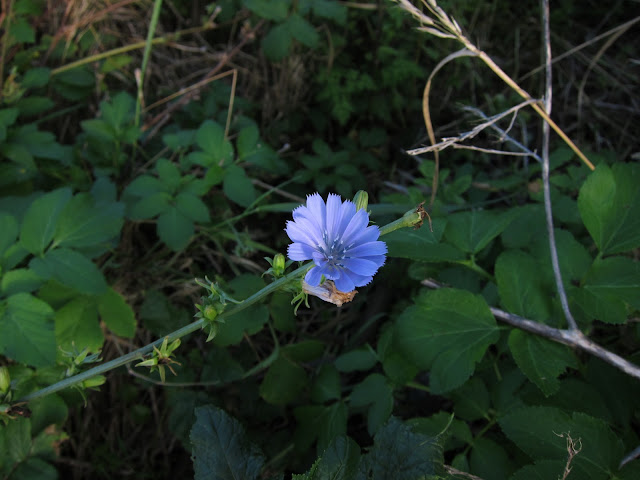
Chicory


And an insect drinking in a yellow flower.

* * *
The Keats quote is from The Eve of St Agnes  and can be found in full on the Poetry Foundation Website

There will be a box for Tree Following posts here on 7th September. It will stay open till the 14th.
To find out about Tree Following
go to the Loose and Leafy
Tree Following Page


Friday, 2 January 2015

TREE FOLLOWING - THE NEXT LINK BOX IS ALMOST HERE!

Sycamore and moon - with the cliffs of Purbeck in the distance.
Sycamore


January!

Branch of Holm Oak leaves with slip stream across evening sky.
Holm Oak
And welcome to new Tree Followers. The band is still growing!

Most of those who began Tree Following last year (last year!) are keeping with their chosen trees for a full twelve months. (Thirteen might be a good idea so a straight comparison between the two start months can be made. What do you think?)

But some Tree Followers (I think) are starting with new trees to mark the beginning of a new year.

It's as each of us wishes. It's a flexible feast - and one of the reasons new Tree Followers can be added to the list at any time in the year.

But whichever month you start, whether you mark your 'year' by the calendar or twelve / thirteen months . . . Have a happy 2015. Find yourselves fascinated by the trees you are following. Have a good time blogging!

Turkey Oak bud getting ready for Spring.
Turkey Oak

This post is really an advert - a reminder that the next Tree Following Link box is almost upon us.

It opens at 7am on 7th January and closes at 7pm on the 14th. (Both UK time.)

See you there!

All photos for this post were taken on the evening of January 2nd 2015

Sunday, 16 November 2014

MUSIC AND ART ABOUT TREES

ABOUT THE TREE ARTS PAGE

Sycamore on November 15th 2014

Have you mentioned music about trees on your blog?

Have you shown pictures about trees?

Have you found fun words about trees?

Have you made a video clip about your trees?

. . . . We're constructing a special page about trees in the arts. (And 'art' includes your own and that of your friends as well as known singers and painters and . . . )

Hopefully it will be well under way by Christmas so do email me with links to the relevant posts on your blog.

AND . . . you don't necessarily need to have posted about a picture , a piece of music . . .etc. etc. (!) about a tree; if you think it's a good tree-in-the-arts link . . . let's have it!

AND . . . it doesn't necessarily have to be about a tree that's being followed now. Who knows what trees will be followed next year? Let's have the links!

Email your ideas and links to
looseandleafy@googlemail.com

or leave a comment on the blog.

Hawthorn on 15th November 2014

THE NEXT STUCK FOOT POST

Every so often I choose a place and put my feet on it so I can see what I can see without moving. I allow myself to swivel, crouch, stand on tip-toe - all those kinds of movements - but my feet have to stay in exact same place. 'Stuck Foot Posts'.

There's a page about them and if you'd like to stick your foot somewhere and post about it . . . There will be a link box on Loose and Leafy from the 21st to the 25th November. Anyone can join in. The emphasis is on plants but there may be other things of interest which you might never have noticed without sticking-your-foot: insects, stones, surprising views. Look under and over and in between. Examine.

(If you'd like your name and blog included in the list of occasional Stuck-Footers. Let me know! - usual thing . . . email looseandleafy@googlemail.com or leave a note in the comments - simply stick your link in the Stuck-Foot Box . . . 21st - 25th November and every 'odd' month after.)

(More about ivy soon.)

Friday, 16 November 2012

A POST IN GREY

One of the delights of autumn is the way the skies swing between grey and blue. How a plant 'looks' (it's emotional appeal to humans) is closely connected with how brightly the light shines. There's something cheerfully heart lifting about crisp colours and lots of easily discerned detail. When colour and detail vanish, texture tends to vanish too. We are left with shape and awe.

Silhouettes of the 'keys' of the tree (seeds) twigs and branches against a grey sky.
November 15th 2012
Immediately - a problem with ID.
Is this the top of a sycamore or maple?
Looking around for an answer, I've come across a tree called
Sycamore Maple
(Acer pseudoplatanus)
Descriptions suggest we might not only confuse this maple with sycamores
but, in some seasons, with plane trees too.
Confusion comes easy!
Meanwhile, I don't know what this pretty tree is.

This is one of my favourite times of year and, although I realise it would be boring to have non-stop silhouettes, I'm always pleased when these newly re-revealed structures of the natural world re-appear against the sky.

One large and several small leaves of the tree silhouetted against a grey sky
November 15th 2012
This is very top of the tree above.
Asking if anyone knows its identity
would have made more sense when it still had leaves!
BUT - once one knows . . . 
being able to identify a tree from its winter shape would be a handy skill,
don't you think?

As ever, I'm aware I have taken these very same pictures before - same plant, same angle, same blank grey sky. It's almost like the annual school photo. The subjects up, fix their smiles and - zam, that's them to put in the album. Once I like something, I tend to get stuck on it. When I see the same shape as last year, I find it oddly heart warming. But, this time, old scenes have given me a new idea.

The silhouetted of old blackberries on bramble against a grey sky
November 15th 2012
This blackberry loop is hanging from the elderberry tree I'm 'following'.
The clump is so well covered with ivy and brambles, I missed it shedding its leaves!

When I'm trying to identify a plant or tree (and this can be a very ordinary plant or tree, I rarely come across anything exotic) I plough around blogs and ID sites and, of course, upload pictures to Ispot (which I can never plug enough!). But it's often difficult to draw things together. There's a real leaf here, a drawing there, a diagram of tree shape, a flower alive but not what it looks like when it dies. Very hit and miss - and will remain so. Apart from all the other practicalities, every leaf is different. Each tree has a history written in its bark.

Blackthorn leaves, twigs, branches and thorns.
November 15th 2012
These are blackthorn leaves.
Blackthorn belongs to the plum family. In summer, its leaves are glossy and dark green.
Its autumn transformation is startling, more so than in trees like sycamores whose
autumn leaves, apart from a change in colour, aren't much different from their summer selves.

The range of plants and trees I cover in this blog is very, very narrow. The challenge of this is to keep it interesting. The advantage is that I have a lot of pictures of the same ones at different times of year. Even then, there are glaring gaps. I may photograph the same branch every autumn because I welcome the re-emergence of its shape . . . but miss the bark every time round. Even bark changes. A sudden downpour and its colours are altered in seconds.

Hawthorn leaves silhouetted against a grey sky.
November 15th 2012
Hawthorn leaves.
In spring, hawthorn leaves are a delightful light green.
The blossom (May) comes later and tends to hog attention till the autumn
when the berries (haws) steal the show.
Meanwhile . . . don't forget the leaves!

So . . . a new discipline. I'll look for a way of gathering pictures of individual varieties of plants into separate, easily accessible albums. I tried doing this with elderberry a few years ago by giving it its own blog. The project foundered. And the labels in the side bar aren't a lot of use if help is needed with ID because they link to posts, not pictures.

Dead Buddleia flowers and leaves silhouetted against a grey sky.
November 15th 2012
I'm a fan of buddleia bark.
(I'll have to look out old pictures - and add some new.)
I like dead buddleia flowers (like these) - but not when they're live -
their florets are packed so densely, there' something disconcerting about them.

The discipline in this is double. First, it might be boring. Indexing takes a special kind of mind and a lot of time. The other - and this simultaneously enlivens my interest and makes me feel guilty because it highlights the gaps . . . why do I not have more pictures of bark? But . . . . I'll see what I can do . . . and if you have experience of drawing things together in this way and have advice - please do share it if you are willing.

Gorse branches silhouetted against a grey sky
November 15th 2012
Gorse against a blue sky spells summer heat and picnics.
It's grey-sky shape has a starkly different atmosphere.

A sad addendum.

As UK readers (especially, I think, those of us in England) will be all too aware - our Ash Trees are under threat from a fungal infection called Chalara fraxinea (Ash Dieback). Potentially, it can kill almost all our ash trees (Think Dutch Elm Disease).

The tops of ash trees silhouetted against a grey sky
November 15th 2012
Two Ash Trees.
When the undergrowth pulls back a bit for winter, I'll see if I can get closer
to show you the trunks as well as the top-most leaves!

The picture above shows the edges of the tops of two young ash trees. We are all being asked to keep an eye out for Ash Dieback. This will be a new kind of tree following - a sombre one. Do click this Forestry Commission link . Towards the bottom of the Forestry Commission page, there's a short video. If you have a moment, do, please, watch it. It's both interesting and important. Important because the only way to stop the spread of this disease is by taking out affected trees. Specially interesting beause it shows not only the external signs of the disease (the leaves, the lesions) but what is happening inside the wood too.

* * *
Tree following symbol
The latest tree following post I know of is
from Gary Web at Compton Verney.
Not only is he following it through its seasons
but a family has adopted it too!

Plane Tree - Autumn 2012

Have you updated your tree?

P.S. All photos in this post are in colour.

Sunday, 18 March 2012

PATHS AND THINGS

Blackthorn blossom is far from covering
the bushes yet
but it's beginning to bulk up;
a few clusters now
rather than an occasional flower.
Writing this post has been something of a struggle. I'd decided to write about paths - paths for humans and paths created by animals (mostly by dogs, foxes and badgers round here). It gives a bit of context - something which, I think, is often missing on Loose and Leafy. From time to time I try to make up for this but doing so has challenges. For one thing, I am privileged to have access to such a rich and varied environment, the wider scene could easily nudge out the detail - and it's the style of this blog that I focus on small details. (Leaves - rather than trees; what one can find without moving a foot.) Another challenge is that, because this is the internet, I prefer to be hazy about some locations. I say 'some' because several are utterly distinct and some unique! There's no getting away from the silhouette of Portland! And, finally, Dorset is such an incredibly beautiful and interesting area, Loose and Leafy could easily become an outpost of Tourist Information; an advertisement for wonderful holidays.

Writing a post about paths hit all these challenges, plus three more. One, that I took so many photos for it, I'd have needed to change the name of the blog to 'Trodden Ground'. Two, that there are other things I wanted to fit in today - it is spring, after all! The third challenge is that there are paths interesting enough to include in a wider-context post but which aren't, I find, the richest source of material for Loose and Leafy.

Never mind - here goes with a random selection and a truncated version. We'll start wide - and narrow down.

This, clearly, is the route of an old railway line. You can see the remains of a long platform on the left. A few years ago, someone proposed re-introducing trains and tracks. It would have been a lot of work and a lot of expense but the man who brought forward the idea had a lot of enthusiasm and, I think, saw it as an ecological idea - a way of encouraging people to use public transport (even if privately operated) rather than cars.

The vegetation along here does not look exciting at present but there are lots of brambles and gorse.
In the summer the air vibrates with heat and pollinators.
Quite a few small flowers - like vetches and cranesbill - grow along the sides.

I think the train enthusiast was taken aback by the vehemence of opposition. This path is incredibly well used. Finding a moment when there aren't people in view is very difficult, especially on a sunny weekend, Sometimes, parts of it get so crowded it is hard to find a route through. I took photos of it being busy - locals going to and from town, walkers, joggers, people with tripods and binoculars who'd come to spy birds, and children learning to ride bikes they were bought for Christmas which have been brought back out again now the weather is getting warm - but as I avoid pictures of people when I can, I decided to show you what it looks like in a calm moment. The person in the distance and the shadow of a cyclist can represent all those who use it. They are good symbols. It can be a peaceful place to walk but there are also conflicts between cyclists who think it's a 'proper' road and people on foot - who don't.

This is part of The Hamm -
the path which runs along the causeway to Portland.
This may not seem hopeful ground for plant watching but . . .
just wait!
Before long, there will be a sea of pink thrift along here.

This area, down in a dip and surrounded by Holm Oaks,
is genuinely short of plants all year round.
In part this is because of the trees.

In part because it's a good place for people to
clamber about a bit or
to abandon supermarket shopping trolleys.

Here's a way to the sea. The reeds are a bit higher than I am.
(I first showed this photo on my other blog, Message in a Milk Bottle.)

Here's a way I never go! It's a way made by animals. I doubt even children go down here.
As well as foxes and badgers - rats and squirrels take advantage of these cuts.

Here's the path between the elders we are following.
In the winter, there's room for children.
Already though, vegetation is beginning to crowd in.
Before long, it will be almost impassable.

The elder shoot we have been following (up on one of the branches) has hardly changed. Others near it are growing faster. I'm glad I chose this shoot though because it means I can keep taking pictures of the lichen as well - Common Orange' (Xanthoria parietina).

* * *

One of my first incentives to follow the progress of a particular tree or patch of ground was when some of the trees round here were cut back in what seemed to me to be a brutal and haphazard way. I was concerned rot would get into the bare and ragged ends of small branches. Some were on trees I recognised. But there was one tree - with beautiful twigs, chestnutty red, which I simply couldn't identify. Not in a way I could be confident of.


I am on Twitter and a friend there suggested silver birch. I said I'd go and look at the lower part of its trunk once the undergrowth had died back for winter. I could never get there. It is as protected as effectively as the sleeping princess was by brambles and briers. Just before the nettles grow up and the leaves break out to make the trunk invisible as well as inaccessible, I've managed to zoom in (hurray for cameras!) and get a glimpse.


Looks right?


And another ID problem. As I've mentioned before, I find it difficult to tell the difference between maples and sycamores in their variety.


A couple of weeks ago, I bought a book which may help with this because it has examples of the different shapes of their seeds. The ones on the tree where this twig grows will be specially lovely. (I know from passed years.)

It will be a long wait. These leaf buds seem pretty static.

* * *

I'm Following a Tree
Are You? 
___
If you have posted recently about the life of a particular tree you are 'following', let me know and I'll put a link here.


On the Edge Gardening
Warts and All
(Beech)
Lichfield Lore
Sticking it Out
(Cider Orchard)

Saturday, 25 February 2012

FEBRUARY PRICKLES

The comments here have got themselves detached from their post 'February Prickles'. To read the post they belong to - click HERE.

(Apologies!)

Saturday, 28 January 2012

THE NEW TREE - SAMBUCUS NIGRA

A few weeks ago, Laura at Patio Patch asked if I will be focusing on a new tree this year. I'd already been giving this some thought. My affection for 'last year's' tree (a Sycamore) began long before I gave it a special place on Loose and Leafy - so there's no way I'd let it out of view. However, it has the disadvantage of being so tall, all the 'action' happens high up. At ground level, shade and location mean its not a good place for other plants to grow . . . what little there is that struggles into life between its toes tends to get nibbled as soon as it shows its head above ground.

So a shift of focus might be a good idea.

A long time ago, I decided to 'follow' several trees and several patches of ground. All sorts of things went wrong - branches were lopped, the undergrowth was cut back, little plants died in drought or were trodden on - other plants caught my attention! In other words, it didn't work. None the less, there's an elder that has kept my interest all the way through. It's a scraggy thing - hardly a tree at all and only specially noticeable because it's bulked up by being part of a small clump. And the clump is both extra-noticeable and extra-easily-ignored because it is almost enveloped in blackberry and ivy. (Some of the recent photos of ivy berries were taken there.)

So, without abandoning the sycamore, let's shift focus and keep a little more of a conscious eye on the Elder - Sambucus Nigra.

It will be an incredible contrast. While the leaves of the sycamore are 'up there' and almost invisible (so high are its trunks before there are branches) the elder is definitely eye-level. And where the vegetation round the sycamore is sparse, so many plants like to live by and on and over the elder, it is sometimes hard to see it!

Deep breath . . . and a little fanfare . . . 
Tarantara!
and we approach the elder . . . through January gloom!


It's on a path we've met before - an old railway line that has been re-surfaced for pedestrians and cyclists.

There's the clump, up ahead on the left. (Further ahead still, on the right, you can see a group of Holm Oaks (Quercus Ilex)).

And we arrive.

For much of its route, the old railway runs along an embankment so, although the tree is easily accessible from this side, there's a quite a steep slope on the other.

Photographs can give the wrong impression of size. The elder is the wonky tree on the left. The little path which runs beside it is nothing more than an animal track. Maybe children push through from time to time. I'm not sure. Dens along here are not entirely out of fashion - though their occupancy seems to be very short - no sooner are they made than they are abandoned.


This is the foot of the tree - red shoots already showing. (I've heightened the contrast so you can see the patterns in the bark.)

Because the elders here are tightly packed, I'm not going to be too particular about which branches belong to which particular tree. We'll take the clump as a unity.


An untidy one!

Useful Link

The Woodland Trust has an interesting page about the Elder HERE
with information botanical, historical and folkloragorical.


'Festival of the Trees' has now become 'Treeblogging'.
'The Tree Year' has come to a stop - or has it?

Saturday, 19 November 2011

WALKING INTO THE BLUE

There's a little path I like. It goes down to a little beach - and I often go there. You've been with me before. It takes about one and a half minutes to walk down and the same coming back - probably less- yet the undergrowth is so dense and varied, I could write a post a week about this one short stretch and there would still be more to see.

This is a little of what I saw on 17th November 2011.


At the top of the path - Chicory Flowers.

A few years ago, I complained to our local council that it cut back blackberry bushes when fruit was on them - and, at the same time, raised questions about the spring trim in relation to nesting birds. I don't claim it was my email alone which got it changed. Indeed, it may have had absolutely nothing to do with it but, since then, the autumn tidy has happened later - and they've just done it so only the shorter chicory plants are still standing. They've had a bit of a tough time this year because the spring trim happened immediately after the first were tall. They are one of my favourite plants so I was pleased when others grew to replace them. I will miss the tall white stems they would have left through the winter if they'd been left uncut but there's no point in a path if you can't walk along it!


Summer here lasts long - right into autumn. Here's a Viper's Bugloss plant. It too has been cut. It has to be done - but look it was still in flower when it fell!

Also at the top of the path - a small maple. (You'll know from previous posts that I'm no good at distinguishing trees in this group so you may say "No! It's a sycamore!" or . . .) (I hope you won't pop up and say no! It's rhubarb!)

The light is uncertain. It flickers between sun and no-sun. The sea is impressive whatever the weather but, since this post is called 'Walking into the Blue', let's choose a sunny moment.

It's evening in mid-November so the sun is low and there's a glare on the water. It's also the time of year when seaweed washes up in bunches.

Back up the path and, caught in the blackberries (you could cut them back for a million miles and we wouldn't run out of blackberries!)  . . . keys from the maple / sycamore / (or even rhubarb!).


Autumn.