Until July 2017, documenting the seasons of coastal Dorset. I'm a complete amateur so don't trust I'm always right. If ever you see I'm wrong - whether with identifications or in anything else - do say! Meanwhile . . . I've now moved to Halifax in West Yorkshire. Click on the link below to collect the new URL. Don't forget to follow there!
Showing posts with label RED ADMIRALS. Show all posts

Thursday, 18 September 2014

BODY PARTS

Red Admiral butterfly on buddleia flower
This is a Red Admiral butterfly (Vanessa atalanta) on a buddleia flower. It's a familiar sight in late summer - especially along parts of the South Coast of England where Red Admirals gather before migrating to Africa in advance of the winter. It seems an impossible task for such fragile beings. But there you are, many facts seem impossible but are true. I'm getting into a tangle!

I've never counted Red Admirals on a Buddleia. For one thing, I hadn't thought of it till just now - and now is too late, mostly they are gone. For another they don't stay still. They aren't fluttering around all over the place, they sit a while, then move to another flower; it's a slow but shifting scene.

Red Admiral butterfly on buddleia flower - closer. With half open wings.
We zoom in closer
Red Admirals are dramatic. Red and black showing clearly on the bushes. When I remember them I nearly always think they are bigger than they really are (wing tip to wing tip) and photographing them is a bit awkward. They move. Buddleias aren't tall trees but one can rarely get close to a butterfly sitting on one. The most important thing, I've found, is not to let a shadow fall across them. They find this more alarming than being looked at close to - but close to is difficult when there's a ditch in the way.

So . . . it's easy to be aware of only three things; that are lots of them, that they are brightly coloured and they like buddleia. Which is why I decided to look at them in detail. And for the reasons listed the detail won't be high quality (especially if you're viewing on a large screem). I like my camera but it's stretching it a bit to do well when one zooms in and crops. Never mind. You'll get the gist. I think you'll be impressed - not by the pictures themselves but what they point to. A butterfly is more than red and black with bold bits of white.

A Red Admirals wing from the side.


Sideways look at a wing.

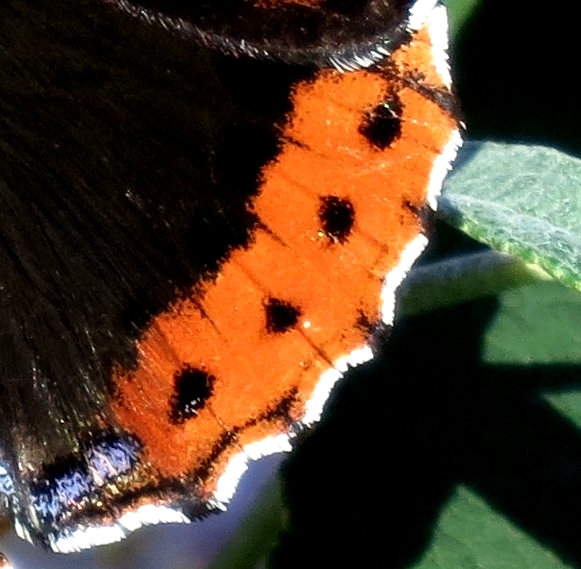
The orange curve of a back wing showing black spots, white edge and flash of blue


The edge of a back wing.

Closed wing of Red Admiral - brown with hearts and orange wavy line


A closed wing.

Profile of Red Admiral's head showing antennae


Antennae.


Proboscis of a Red Admiral plunged into the centre of a buddleia flower.


Proboscis. A Red Admiral drinking nectar.
It's why they're here.

Head of Red Admiral with eyes clearly seen.


It's looking at you!

Site Recommendation.
And in particular because it's relevant to this post, the section on Butterfly Anatomy.


(Bother. I shouldn't have told you about this site. You'll be so busy looking at it you'll never have time to visit Loose and Leafy ever again. Ah well.)

And REMEMBER  - there will be a link box for posts about urban wild plants this coming Sunday (September 21st 2014).
For more information, there's a 'Street Plant Bloggers' page. If you are not participating this time but intend to - maybe in April - let me know in the comments or email me at looseandleafy@googlemail.com and I'll add you to the list as an occasional street plant blogger.

You might also like to see a previous post on Red Admirals in early autumn. 'Ivy and the Butterflies' was posted on October 14th 2014. (I think the pictures are better there.)


Monday, 13 May 2013

IF YOU WOULD LIKE TO USE MY PICTURES - AND A RED ADMIRAL BUTTERFLY

Red Admiral butterfly (Vanessa atalanta) on gorse flowers. May 13th 2013 - Wings open.
Red Admiral butterfly (Vanessa atalanta) on gorse flowers.
May 13th 2013

I belong to a Google Circle for garden bloggers. This isn't a garden blog so I count it a privilege to have been invited to join. Over the last week, there's been an interesting and extended discussion about copyright, watermarking, meta-data etc. . . . and always in the background is the question of whether or not we are happy for our photographs to be used by others.

I've found this very helpful in re-crystallising how I feel about my own pictures and as I think it is different from many (possibly most) other bloggers, Diana Studer (of Elephant's Eye) suggested I write a post to make this clear. Good idea!

Without waffle - I will be delighted if anyone wishes to use any of the pictures on this blog as long as they are not of plants taken in an urban setting* and as long as they are not to be used for commercial purposes. (If anyone has a commercial use for any - contact me at looseandleafy@googlemail.com)

Red Admiral Butterfuly (Vanessa atalanta) on gorse flowers May 13th 2013 - Full face view showing curled and withdrawn proboscis.
Red Admiral Butterfuly (Vanessa atalanta)
on gorse flowers May 13th 2013
If you use one of my photos on your site and let me know, I will be pleased. If you link back to Loose and Leafy, I'd appreciate it but it isn't necessary and I won't be offended if you don't. However, I would definitely like you to mention it was me - Lucy Corrander - who took the photo.

Nearly all the recent photographs have been reduced in quality to help the page load quickly. If you would like me to send you a jpeg version of a picture with it's original quality maintained (so there's better detail) - I can do that. If you have a commercial purpose in mind and we agree terms of use, photos in RAW are available for most pictures from early 2012.

Red Admiral Butterfly (Vanessa atalanta) with its wings closed. On gorse flowers. May 13th 2013
Red Admiral Butterfly (Vanessa atalanta) with its wings closed.
On gorse flowers. May 13th 2013

BUT . . . and this is a really, really, really important 'but'. You must bear in mind I am not a naturalist. I try to ensure my identifications are accurate but mistakes will, inevitably, creep in from time to time. If you use any of my pictures, you must either make sure to your own satisfaction that the ID is correct, or say you can't guarantee it. AND because I have sometimes realised a mistake after uploading it to the blog, the incorrect ID may still be attached to some pictures, even if corrections have been made in the blog itself. SO it would be a good idea to check this before you use an image. If you put your cursor on a picture and right click and chose 'Inspect Element' from the drop down list, you will see details of the picture highlighted. This will generally include the date the picture was taken as well as the ID. If you have doubts - download the picture onto your computer and remove the ID, leaving the other information - image number, date, my name etc. in place. Is that ok?

None of this applies to the text on this blog - only the pictures. If you'd like to paraphrase the information, please feel free to do so - remembering to check I'm right! - but don't simply copy and paste what I've written about anything.

I suspect I will want to change the way I've said this from time to time, phrase it better. Some of you may also see that I've missed things out or been unclear . . . (mention it, please!) I'll put all this under a tab at the top of the page soon so if ever you want to refer to it - you can.

*Urban setting - those pictures which include human made things like cars, buildings, pavements, drains, street lamps, trains . . . those kinds of things.
* * *

(Hope you like the Red Admiral Butterfly! The three views are of the same individual.)

Sunday, 14 October 2012

IVY AND THE BUTTERFLIES


Ivy flower ball surrounded by leaves

Ivy flowers turning to berries
Flowers (at the back - with the stamens
(the bits that look like sticks).
The beginnings of berries at the front.
Right from when we are little, we learn to identify flowers by their petals. Children tend to draw daisies rather than roses and hardly anyone, if you handed them a pencil, would begin with a honeysuckle flower. Even now, I struggle to understand how a flower can have no petals.
Ivy Flower Buds

A petal-less flower seems more like a bud or a ready made berry. To an unscientific mind (like mine) it's bewildering. When is a flower not a flower?

Insects don't have this problem. As I noted last year, ivy flowers attract enormous numbers. This year, there are even more hoverflies (and there were a lot then!). The ivy flowers are clouded with them. Last year, blow flies (blue bottles and the like) basked on their leaves.

Red Admirals on Ivy Flowers in front of Hawthorn Berries (Haws)

At present they are not so prominent but the big surprise is Red Admirals - not that they are here (for this is an ordinary habitat for them) but their numbers. They are big butterflies, a couple of inches across when their wings are open (big for here; maybe not for the Amazon!) and they have decided to become petals for the ivy flowers. 

Red Admiral Butterfly - wings open

To human eyes, that is. They are not hanging around looking pretty on purpose. They are busy feeding. Most are getting ready to fly to Africa. AFRICA!. I'm not sure which is more bewildering - that ivy flowers have no petals or that butterflies fly to Africa. Just like many migratory birds, they mass on the south coast of England, ready for take off.
Red Admiral Butterfly - Wings Closed
The uppersides  of a Red Admiral's wings are so dramatic, they are what usually catches my attention.
Until I took these photographs, I hadn't realised how beautiful the undersides are too.
They help disguise the butterfly when it is hiding on the trunk of a tree.

What surprises butterfly experts is that some of them now over-winter here.What surprises me is that these delicate beings ever leave! In the spring, there will be Red Admirals coming the other way. Something I'm not clear about is whether any are the same individuals. I'm hoping someone reading this will know how long they live. Do you?

Red Admiral Butterfly, Ivy Flowers and Haws in front of Blue Sky

For More Information About Red Admirals

The Red Admiral page on UK Butterflies - Lots of pictures and videos (including a Red Admiral coming out of its chrysalis).
The Red Admiral Page on Adrian Hoskin's site - Learn  About Butterflies - More detailed (but very readable) information.

All photographs on this page taken 11th - 12th October 2012
For Previous Posts Loose and Leaf Posts About Ivy, click HERE


Recent Tree Following Posts

From Hollis at In the Company of Rocks and Plants
Weeping Birch

From Donna at Garden's Eye View
'Surrender'