Until July 2017, documenting the seasons of coastal Dorset. I'm a complete amateur so don't trust I'm always right. If ever you see I'm wrong - whether with identifications or in anything else - do say! Meanwhile . . . I've now moved to Halifax in West Yorkshire. Click on the link below to collect the new URL. Don't forget to follow there!
Showing posts with label STREETS. Show all posts

Wednesday, 26 October 2016

STREET PLANTS AND STREET PEOPLE

Sow thistle on wall after flowering.
A sow thistle growing on a wall may flower and thrive.
A human with no-where to go will be less successful.
As you know - can't fail to have missed - I am impressed by street plants. They live in shop doorways and gutters and flourish there. People don't.

You may also have gathered from previous posts that I visit Oxford from time to time. What I haven't said in these posts is that while photographing street plants, I've been taken aback by how many people live on pavements there too. I mean, in almost every town people sleep rough - but in Oxford, to an outsider like me, the visible numbers are shocking - so many doorways are every night turned into cramped, temporary bedrooms.

Sycamore tree growing in rain drain.
The sycamore tree in a drain we have followed for the last few years
still lives but is getting a bit cramped.
Drains are not meant for trees - nor shop doorways for humans.
June 2016
I don't understand. Oxford is a place with one of the best universities in the world. It's a place stodgy with outstanding brains. You'd have thought they could have set aside some time to put their intellectual heads together and work out what can be done.

Meanwhile, council funding for charities working with and for homeless people in Oxford has been cut by £1.5 million this year.

I don't want to go on about Oxford over much. It's just happens to be where I get most shocked. It's the place where I think about homelessness more than I do anywhere else - even more than where I live. It's the place where I think, over and over "what are minds for if not for addressing these kinds of basic needs?" And it's where (I expect you were waiting for this . . . ) where I know someone who is taking part in an event to raise a little of the money charities need to help those who are homeless, or newly homeless, or newly with a roof over their heads. Having somewhere to stay - though important - is not the end of the matter. It means a life-style change and that doesn't necessarily come easy to everyone.


Two plants in a dry kerb
Weymouth, June 2016
It's always hard to think of an event that will draw people to raise money, to raise consciousness, to 'make something happen' without it being naff or offensive. Selling jam to raise money for famine victims it's . . . well, there's something uncomfortable about it. So it may be that the group of students and local citizens who will be 'sleeping-out' for one night may find it a bit awkward . . . Being in the open for one night is not the same as curling up under a cardboard box every night in November. However . . . however . . . however awkward it feels . . . sometimes if money is needed you have to go with the ideas you come up with; ideas that are within your reach to fulfil

By clicking the link you'll go to the Just Giving page of a first-time fundraiser. She won't be the only one coming at this from scratch but she happens to be the one I know . . . And while each participant has been asked to raise £100 by being cold for a few hours . . . it would be good if every one of them were to raise more, for it's not for themselves they are doing it.

If any of you do feel moved to give - perhaps you will think of those street plants
And how people are rarely as resilient as they are.

Money raised will be shared between

Photos in this post were taken in Dorset, not in Oxford. But these kinds of plants live in both places.


P.S. I suddenly realise it looks a bit odd, exhorting you to give when it seems (from the list) as if I haven't done so myself! But due to the nature of my card I had to use the 'anonymous' option.

Tuesday, 21 April 2015

BACK TO BLOG - APRIL STREET PLANTS


Clump of tall dandelions by gas meter box.
People who leave dandelions to grow
outside their houses instead of weeding them away
are right to appreciate such beauty.
My laptop has come back from the menders with a new vocation.

While away it was sent back to factory settings so it's decided to dedicate its life now to incessant up-dating. Slow, slow, quick, quick, slow.

Still. It's pleasant to have a new keyboard; and for the mouse pad to work; and not to need to press the same buttons over and over before anything happens.

There are, of course, masses of things to catch up with so I'm only partly here. There are on-line bills to check, emails to send and a general gearing up. Over this non-computer period I've been doing different things and it's odd how odd it feels to be returning to normal. It's that funny kind of feeling at the end of the long summer break from school. It means you will be seeing your friends again - but affection for being on holiday lingers on.

The sun has come out to celebrate so I've been on a quick look around for plants growing in the streets.

Dandelions where playground and pavement meet
Where playgrounds meet pavements - that's a good place to look.

Dandelions come at the top of my list of favourites and, all of a sudden, there are loads of them.

White flowers and dark brown seedpods on Shepherd's Purse plant


Shepherd's Purse (Capsella bursa-pastoris) with its tiny white flowers and heart-shaped seed pods also comes pretty high on my street-plant list.

Purple leaves crossing dried earth and stone edge to pavement


Then there are the leaves of an up-and-growing Smooth Sow Thistle (Sonchus oleraceus) with a purple so astonishing it doesn't see quite 'right'. Such a colour would be a surprise in petals. But these are leaves! Leaves! (It will grow greener as it grows taller.)

Dry grass has flowered at foot of blue leg of slide


And then there is grass in its many states and varieties. I really do like the single plants which pop up through tarmac, grow beside bench legs and establish themselves between paving stones. This little lawn has already dried out and gone to seed.

Have you been noticing new plants in the streets near you?

If so, why  not post about them and put a link in the box below?

It will be good to see what you see too.

The box will be open till 7pm on the 25th April.

* * *
Apologies to everyone who's been waiting for me to reply to emails or for their trees to be added to the Tree-Following list. I'll be catching up gradually.)

Thursday, 19 February 2015

OVERWHELMED BY BEAUTY (AND A GALLANT ATTEMPT TO INSULT MY READERS FOR THE SAKE OF FILTHY LUCRE)

I have this bizarre idea that the harder anything is to find the more beautiful and interesting it will be. Naturally, this is not borne out by experience. I'm perfectly clear that if I want to see unusual plants I'd be better off in botanic gardens than in my local park where tennis courts take precedence over hot-houses.

There are some ideas which matter. If I decided to murder three people a day it would have an impact on society and it might be a good idea that I be stopped. But if I want to potter round in dull streets on dull days when it's so cold my hands are shaking with shivering and search for urban wild-plants where there seem to be none instead of heading off for places where I know there will be plenty . . . perhaps you will forgive this eccentricity. Or even recognise in it a spirit of adventure usually lacking in a road of unexceptional suburban housing, along with a spirit of genuine scientific enquiry.


My 'spirit of adventure and enquiry' seemed to have come a cropper when I went out on Wednesday lunchtime. (Sporting a woolly hat, not a topee and bare fingers because I'd left my gloves at home.) I seemed to be about to prove my theory that plants are everywhere . . . wrong.

It's happened before. I've chosen a street, marched along it brimming with confidence, found the confidence shattered by the lack of wild greenery and then . . . found it in abundance. Or if not in abundance (which it usually is) I've found some physically there.

Here's a little grassy lawn. No upkeep needed!
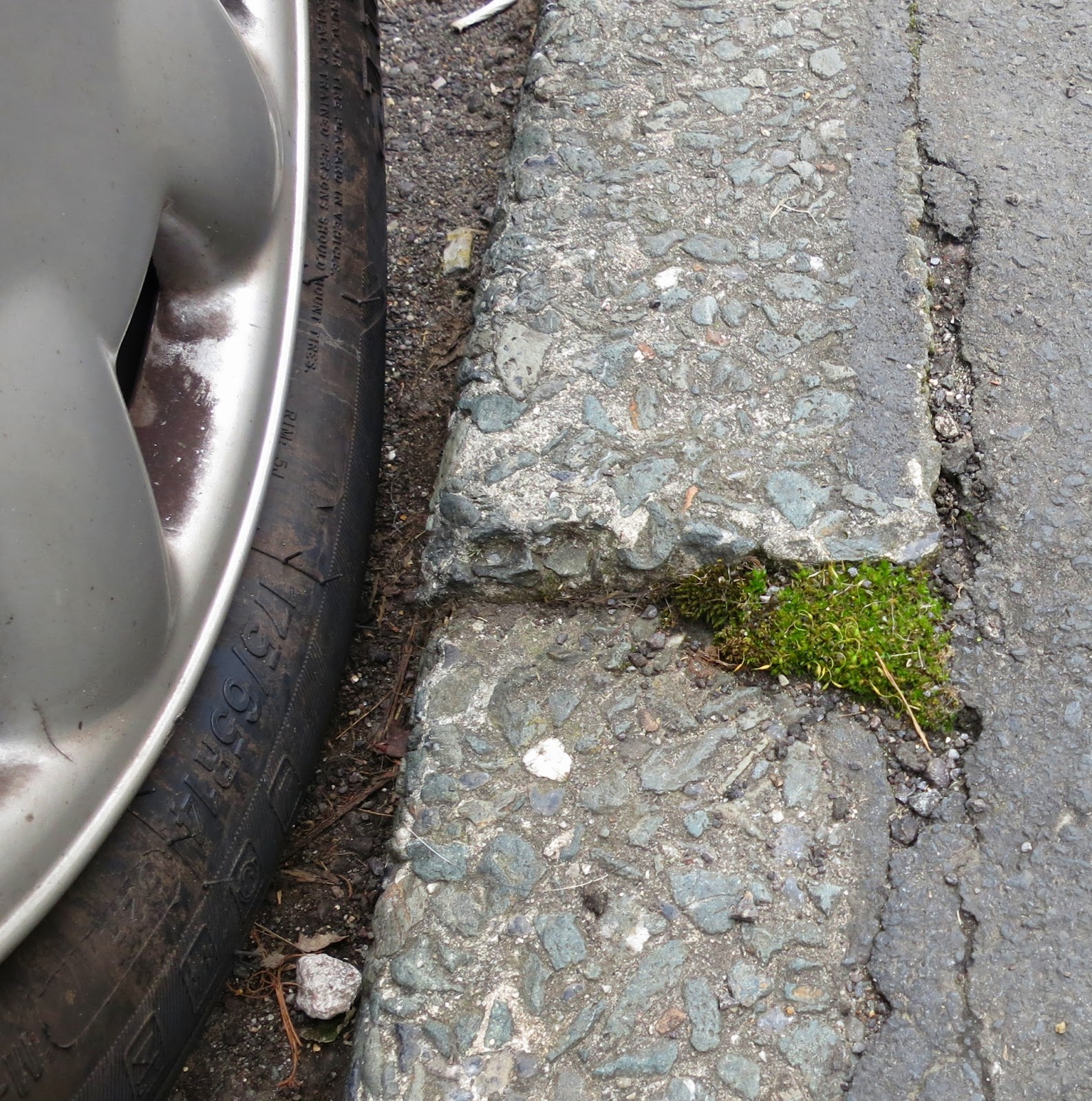
 I was already composing my post to say 'Sorry, I was wrong, February is an exception,' when I realised I was thinking too large. This was an unsheltered spot; long and straight with the wind blowing in from the side as well as up the middle. Plants which might have weathered through winter in other places hadn't managed here. The shelter I should be seeking wouldn't be beside waist-high garden walls along the path, it would be right down low in the road. In the Lilliputian / Borrowers world of small plants a kerb is a tall wall. And where cars park, the gap between the wall and tyres becomes a chasm. New motto for the coldest month 'Think Grand. But Think Small'.

And another thing. The more time that passes, the more I couldn't care less what plants are called. Their 'thereness' is what enthrals me. Really. If I were to take a photograph of a crowded street, I would expect virtually every human caught in the frame to have an interesting face. But I wouldn't rush up and down asking them for their names.

The green blob is not grass - it's a not-very-attractive patch of moss.
A prettier specimen comes later in this post.
I know, I know, I KNOW . . . we've had this out before . . . that the names of plants matter. And I KNOW that Loose and Leafy is an odd kind of blog and I probably owe it to my readers to find out what things are called so useful information can be recorded and passed on. BUT . . . er . . . I doubt many of you care two hoots either. When it comes to garden plants - that's different. If you see a good one on somebody else's blog, of course you need to know what it is so you can buy one if you would like one in your garden too. But, seriously, no-one is going to read Loose and Leafy and say 'Oh boy! Wouldn't I just like one of those little weeds to plant by my car. I must, I must, know what it is.' Of course not.

Though some . . . some are romantic. The Latin name for Common Whitlow grass is Erophila verna - which, roughly translated, means 'This plant loves spring' which is much better than naming it after a sore finger! But as it isn't yet spring in a decidedly 'sprung' sort of way, we'll have to wait for March before I start crawling around looking for that.

Not a wild plant but the head of a carnation lying in the middle of the path.
Do you know the programme 'Top Gear'? It's a programme about cars and I love it. It is extraordinarily sexist and I am a feminist - but I enjoy it just the same. It shows cars in remote and exotic places - hills, heather, mountains . . . and says they are driving around in the home-counties. And viewers are forever writing in to complain about it and point out there are no mountains in Kent or things like that. It promotes dangerously fast driving and I can't bear to be in a vehicle travelling more than about twenty miles an hour. The BBC is forever threatening to take it off the air because the three regular presenters are forever offending people (and the people who take offence may have serious, not pernickety, reasons for being offended.  . . . ). (All these 'forevers' are to emphasise how relentless the programme is in poking fun at people who might be offended. It's not an occasional slip. And it's relentless in it's never changing format too.)

I've recently come to realise how much my blog is like Top Gear. I know in advance that when I show pictures of litter here or my other blog (Message in a Milk Bottle) or fail to give proper recognition to the names of plants  - I know someone will (quite rightly) complain about litter or protest the importance of Latin. So I'm feeling rather chuffed.

Top Gear is one of the BBC's top income producing programmes (along with Dr Who) and Jeremy Clarkson (the main presenter) was reported to have earned £14 million in 2013. How's that for an example? Would it be fair to conclude the more complaints you receive the more money you'll earn? A good theory. I'm wondering if I might suggest all botanists have sore fingers . . . . and wait for the millions to role in?

Bother. I was getting so carried away with insulting you I forgot the moss on a wall. It blasted my mind. I'm dumbfounded by its colours. I keep looking at it on screen. Most of it is out of focus because I don't have the right lens for such tiny, tiny plants and my hands were shaking with cold. But you'll still see how overwhelmingly beautiful it is. Close up it's a forest of wonderfulness. Just goes to show - February (in England) is a time for looking small. (I will probably need to work harder on insulting people. Erm . . . suppose I say (block your ears if you don't want to hear this) mosses are prettier than roses . . .  will you send me a million pounds?)


Think February. Think mosses?

And if you would like to contribute a Street Plant Post to the next link box
Think 21st - 25th February

Sshhhh - some possibilities / suggestions
Top plant - Bittercress (probably Cardamine hirsuta)
The little green stars - possibly Pearlwort  (Sagina . . . um maybe Sagina subulata (Irish moss which isn't a moss!)  Or Sagina procumbens . . . ) (You see why it might be better not to bother!) )

Monday, 21 July 2014

THE WILD PLANTS OF SOUTHAMPTON HIGH STREET

At the top of a pedestrian subway in Southampton (but not in the High Street).
This little garden has a lawn and leaves and flowers.

If I have a mission, it's to persuade people that every street is a garden. Not has a garden, note; but is one.

My theory is that in every street there are flowers and lawns and trees and . . . it's just a matter of adjusting your sense of scale and looking for them.


Those of you who have been reading Loose and Leafy over the years will be familiar with my posts about street plants. Until now I've gone to towns I already know so I've had good ideas about where to look.

For the free-range gardener,
trees put there by the council don't count.
On Wednesday I was in Southampton. I've been there in the past but not much. I once went to an art exhibition. I accompanied a friend to a shop where they sell exceptionally smelly soaps. I've visited a road which used to be a wharf but is now a long way from water. That's about it.

The main shopping street in Southampton is broad and for half its length traffic free. At one end there's a lumpy entrance you can walk through or round - The Bargate. (Built around 1180). At the other - where the traffic is - a park. In between are the usual City Centre shops, all built since the Second World War. (Southampton was bombed.) Some have doors opening directly onto the street. Others are in arcades. Some of the architecture is very grand and modern. Some is dated and beginning to decay. There were market stalls the day I was there. And a roundabout.

A little urban lawn.
There was a slightly larger patch of grass by a group of benches
but I would have felt awkward asking people to move their feet so I could take its picture.


Time to put my theory to the test. This is a very busy street. Is it also a garden? It didn't look promising. But there's no point in having a theory unless you put it to the test.


Shopping centres where rubbish is collected and pavements forever swept clean can be arid and dull. From that perspective, Southampton High Street definitely looked dull - dull and dry and lacking in green.

When you can;t see much by looking down - look up.
See the tree? One in an arboretum.
Although it looks alone there are bound to be others in streets nearby.
Birds would know.
Indeed I found a big, flowering buddleia down a left-hand turn. Ferns by a down-pipe too.

It was. I struggled to find anything. There is, I realise, little to show. Indeed, at one point I was wondering whether I should conceal the fact that I'd tried or accept I'd failed and admit it; that my theory had bitten the dust.

Smooth sow-thistle (?) by a bus-stop.
(Sonchus olderaceus)

But no! There was a small lawn, a flowerbed and a tree.

Hurray! Southampton High street is - as you see - a garden.

What's more, there were wild animals. Aphids. Ladybirds!

This Harlequin Ladybird  (Harmonia axiridis )
was on the Smooth Sow-Thistle
above.
See greenfly legs sticking out from its mouth?
To a flock of aphids a Harlequin Ladybird is more dangerous than a lion is to a herd of gazelle. It will chomp and keep chomping.

My theory holds. We're short of rain. It's rather hot. Once the pavement is watered and the gutters have been washed through with rain . . . maybe it'll become a 'Botanic' one. Perhaps it'll go in a yellow book!


* * *


The current population of Southampton is around 237,000.

Southampton is in Hampshire in the South of England.


If you live in the UK you can take part in the Ladybird Survey
which has a picture gallery of kinds of ladybirds to look out for on its site.

There's a downloadable Ladybird Identification Guide on their site too.
Here's a link to find out about The Ladybirds of Ireland.


Do You Post About Street Plants?
Here's a post on Hollis' blog - In the Company of Rocks and Plants
 - Urban Botany, Urban Art and the Instagram Effect
And from Amanda at 'The Quiet Walker'
 - Urban Plants at the Town Hall

STOP PRESS
Irrelevant to post but have just come across this Facebook Page of Moths found by BSG Ecology in 2014. Click on the pictures to find their names.

Sunday, 15 June 2014

STREET PLANTS

Mexican Fleabane (Erigeron karvinskianus) beside downpipe in garage forecourt
Mexican Fleabane (Erigeron karvinskianus) beside downpipe in garage forecourt.
June 12th 2014
Before the post proper - a big thanks to everyone who took part in the June Tree Following update - whether by writing about their own trees or by reading the posts of others. The characters of the trees (and to some extent of those following their progress) is emerging as the year passes - and it's fascinating. Some trees have found their identities or had them revised; it's easier to work out what they are once leaves have opened. Maybe by starting with bare branches we will all find it easier to identify trees in winter? Some trees have run into trouble. Some have burst out of iffy patches. Over the summer months we will need to become even more efficient as detectives - what is happening when nothing seems to be happening between now and autumn? I anticipate our July and August posts will be amongst the most creative and revelatory.


To see the branches of 'my' tree, I have to crane my head back - it's so very tall. So this week I thought I'd look down. The hedgerows seem high at present - with fennel being feathery and the umbeliferous flowers seeming like inside out umbrellas (except prettier). It's all a big green blur, for all the little flowers growing in the big plants' shade.


Spear Thistle (Cirsium vulgare) behind the bins in a car-park recycling area.
Spear Thistle (Cirsium vulgare)
June 15th 2014


So I looked to the streets - or, more particularly, to the car-parks, where plants are more likely to grow separately. Here, they are more distinct. And astonishing. And pretty.

And not just pretty (like the Erigeron (Mexican Fleabane)) above. Resilient and surprising like this Spear Thistle (Cirsium vulgare) behind the bins in a car-park recycling area.

Poppy and buddleia beside white pipes by chain link fence round building site.
Poppy by building site. See the buddleia to its left? Opportunists both!
June 15th 2014
Where there's a new building, there's often more new building in progress nearby. It's how towns spread! On the edge of the car-park belonging to a three-year-old supermarket, something else is being built. I don't know what. The ground is cleared. Machines are there. And pipes and chain link fences all around. Where flowers grow.

Close up of red poppy showing seed pod inside.


Faded beauty!
There were newly opened poppies too, bright red and with unblemished petals. But in this flower we see the seed pod forming. It's like watching a caterpillar turn into a chrysalis - the old and new entangled. But it's not just that..


Aren't the curls and dents, and wrinkles just as beautiful as the flat blandness of a young flower. (Say yes!) I'd be hard put to it to tell one new poppy from another. But once they begin to die - that's where their individual character creeps in. Or leaps in, in the case of a poppy, because the petal stage doesn't last long! 


For more Loose and Leafy posts about plants about town - click HERE.
For more about Tree Following - click HERE.

Friday, 15 November 2013

OUT ON THE TOWN

One of my mantras - to look up. Another, once you are up - look down.

There are special places I return to over and over. Are the same plants there? Depending on the season, the answer is usually 'yes'; if not the original ones, new ones which have grown from their seeds or their roots. Town plants - the wild kind - are as predictable as their hedgerow cousins.

Another reason for returning is to have another bash at photographing plants which 'didn't come out well first time'. (Sometimes they never do.)

This fern is one of several growing on the outer side of a footbridge over a level crossing. The gates don't stay shut for long and it's exciting to stand by the track and watch trains rattle by so whether from patience, laziness or interest, shoppers usually wait till the barriers go up again. Sometimes there are people in carriages. (It's fun being a passenger looking out at the crowds.) Sometimes its a chain of trucks. Sometimes I too stand and wait but I don't like crowds, view climbing steps as a minor contribution to staying healthy - and like to visit the plants on the bridge.

I've never yet taken a really crisp picture of any of the ferns there. I have to reach the camera out over the brick edge and twist it down or back (safe with handrail so I'm not going to tip over) and focus at an uncomfortably short distance which sacrifices depth of field. (Remember, I'm well-pleased with my camera but I can't change the lens.)

Yesterday was no exception. Slightly fuzzy image. Odd angle. But . . .

The train has just passed and a huge column of pedestrians surges over the track in both directions . . . looking at the ground.

They do, of course, have to make sure not to trip on the rails . . . but it's more than that . . . when not looking in windows or checking phones, people do look down a lot when walking along. I do this too - watch my shoes pop in and out of vision. It can be meditative, give a sense of marching forward and purposefulness. Feet are awfully interesting! Hence my mantra - remember to look up.

Look up - and you'll see ferns.


Look behind things and you'll find leaves and seeds. (Even if they turn out at a jaunty angle!)


Look down .

Even underground . . . well, you already know my fascination with drains!


But don't neglect feet level.


Here under a backstreet tree by a multi-storey car-park among fallen leaves and old twigs - about four inches across . . . it pays as much to look down as up. 

And, if you look up - you may see me looking down! If you do - I'll wave.

_____


In my enthusiasm to keep the list up-to-date - I obliterated it. Bother!

But, to me, autumn is the beginning of a new year. It always seems more like new life than new death with everything getting ready for next spring and summer. Always very hopeful. So . . . new list!

Hollis is giving us a really good start with 'Autumn Strategies 1'.

Hollis Marriot blogs from Wyoming in the U.S.A. The terrain is profoundly different from the Dorset land-and-sea-scape I'm familiar with and the plants there often have to use different ways to deal with their environment - one which (it seems to me) is a pretty challenging one. 

Unlike Loose and Leafy - which rambles about discovering things without knowing anything - In the Company of Rocks and Plants gives you proper science too. (Of a very accessible kind.)

Tuesday, 29 October 2013

IN THE GRAVEYARD - OCTOBER 2013

Tomb beneath trees in urban churchyard with buildings beyond.
As part of my 'wild plants that grow in cities' project I recently visited an urban Churchyard.

When I was younger, I used confidence as a power shield. I wasn't stupid enough to imagine this made me invincible but it worked pretty well.

Hanging in my cupboard over the years, un-needed, underused, it's grown threadbare and moth-eaten. But that day I suddenly felt I could do with it again for when I went through the gate I realised the wooded area behind the Church was full of raised voices. I faltered. It was a good guess, I reckoned, that there would be bodies attached to the voices and they might not be friendly bodies.

I'm not a linguist but the voices sounded Polish. There are a lot of Poles in England nowadays. All the dentists at my local practice are Poles and every one of them has been a darned site better at dentistry than any dentist I've had before. They seem to be remarkably adept at treatment without pain. None the less, however good Polish dental schools are it seemed unlikely that these graveyard woods would be full of Polish dentists haranguing each other so, as I said, I faltered. All I could think of was that these were migrants who hadn't found work and had set up an encampment. Would they be happy to have an English blogger wandering through their dispute? I never found out. For all the time I was there loud voices floated from among the trees but I never approached and they didn't emerge to approach me.

I stood for a moment, should I walk forward? It was the third Churchyard I'd tried in an hour. The others hadn't had graveyards - just tarmac, gravel and well tended flower beds. So I gathered up the tatters of my shredded confidence, drew them round me - and walked on.

Within a few steps, I was, once again, disconcerted. A young couple rose from a grassy area between graves. They seemed to be pulling on their real clothes as firmly as I was tugging at my invisible protection. Forward still? Yes. Why not? I slid my eyes aside and walked purposefully up the slope. Steps. A tomb. Plants growing along the plinth. Great!

Plants and fallen oak twig  growing from plinth on tomb.

I was just about to crouch down to get them in frame when two young drinkers clattered round from the other side with cans and a bicycle. Now what? We greeted each other cordially. I explained what I was doing. They asked. if I would like them to move out of the way. I said all was fine. So they sat chatting with each other while I crawled around with my camera. (That's one of the troubles with plants. They mostly grow on the ground.)

I took my pictures, thanked them (after all, I had intruded on their space) and went back down towards the gate. Should I leave? No!

Three, bright red, ripe bittersweet berries and an orange one. (Woody Nightshade.)

Skirting the voices among the trees, I found bittersweet (Woody Nightshade) on the edge of the wood.

Brown fungi and contoneaster (?) seedling in foreground. Tomb below trees.

And fungi near a contoneaster seedling (do you reckon?)

Large, shiny yellow, toadstool-shaped fungi with white gills growing through ivy on edge of woodland.

and more fungi. These yellow ones were several inches across. I didn't touch them to find out if they are merely shiny or slimy too.

I'm not going to attempt IDs.

But . . . after photographing more graves and ivy and a sweet chestnut shell . . .

I hurried away for the train back home - full of puzzles, pictures and a cheerful sense that, with a little bit of work - a stitch here, a patch there - my old and tattered cloak of (almost) invincibility could possibly be worn once again with pride.

Saturday, 27 April 2013

LET ME INTRODUCE YOU TO MY WOODLOUSE

I was out photographing dandelions when I found this one by a pipe leading from a meter box.

April 26th 2013

Of course, it may not be a dandelion. There are lots of yellow flowered plants which look a bit like this and have seed clocks and green leaves and . . . 

And if it is . . . what kind of Dandelion? Tim Rich of the National Botanic Garden of Wales left a note on an iSpot entry to say there are at least 235 species of dandelion in Britain so I won't even try to guess. Not that I mind much, this not knowing. I'm a dandelion fan. To see them is almost enough.

Anyway . . . there I was, crawling along the pavement, trying to get a good angle when I met, crawling towards me . . . a woodlouse. My shadow fell across it. It stopped. I moved back. The sun fell on it - and it continued on its way. I leant forward. The suddenly renewed shadow stopped it in its tracks. Lots of insects, I've found, react instantly to changes in light and shadow and will 'freeze' - or fly. (Not that a woodlouse is an insect - it's a crustacean. Isn't life complicated?) (And woodlice don't fly!) This (the light and shadow thing) can be handy to know if you want to take a photograph. Though it's not such a handy fact if your particular insect/crustacean will only stay still in the shade. Nor is it a long term handy-ness if your woodlouse learns to ignore these sudden changes in light and decides to barge on regardless - as 'mine' did.

So, what kind of woodlouse? Africa Gomez, of the University of Hull, has an interesting post about woodlice on her BugBlog where she mentions there are over forty-five British species of woodlice. Not quite as many as there are of dandelions but . . . still more than I can name!

I don't know whether it had anywhere particular in mind when it set out on its walk or if my leaning over it diverted it from its path but, fairly quickly, it decided to do a loop, march on through light and shade and head away towards the wall . . .

April 26th 2013

. . . where little plants have begun to grow beside a down pipe.

I know you are unlikely to take my advice and kneel on the pavement to see what you can see but . . . there's a lot going on down there.

April 26th 2013

There it goes!

P.S. This is a larger Rough Woodlouse I came across last August.

Rough Woodlouse - Porcellio scaber - August 19th 2012

Isn't it beautiful?

Thanks to Tim Rich (National Botanic Garden of Wales) we now have a link to a 'Plant Crib' on different kinds of dandelion. Click HERE.

Tuesday, 2 April 2013

OH ALRIGHT - THERE ARE FLOWERS TOO!

While bemoaning grey days and bleak economics, one can't pretend that green plants and bright flowers aren't great lifters-of-spirits-ers.

There are the obvious ones for the time of year.

Blackthorn blossoms - white and showing stamens

Like blackthorn blossoms that open before their leaves arrive.

And I am specially encouraged by flowers which spring open in city streets. Ones which live there despite the odds. (Or, perhaps it's odd that we don't expect them and sometimes don't see them there.)

Bud of blue flower with purple tinge.
March 26th 2013

This flower is growing at the top of a flight of underpass steps in Bournemouth city centre. (A city with a population of around 168,000.) It's a Speedwell. Maybe a Common Field-Speedwell (Veronica persica) (which can also be called 'Persian Speedwell' - pretty exotic name as well as pretty flower!).  Or it might be a Green Field-Speedwell (Veronica agrestis). Maybe I'll get a definite ID from iSpot?

Full view of the plant with blue flowers.
March 26th 2013

This is the plant the flower is growing from. As you can see, there are quite a few buds waiting to open.

And between the cobbles of speed bumps in a Weymouth housing estate.

March 31st 2013

Common Whitlowgrass (Erophila verna). Each flower takes up about two square millimeters. These are not growing in a busy road - but dustcarts and cars do drive over them. I doubt (though I haven't stood there to check) that anyone (except me and people who've stopped to ask why I'm crawling around in the road) have noticed they are there.

Oh, and why not

Daisies in grass in front of flats and basket ball hoop.
March 31st 2013

notice the daisies? These are growing in an un-trampled area of a park. Unsurprisingly un-trampled because there is one basket ball hoop and one five aside goal. Not entirely inspiring when both are for team sports!