Until July 2017, documenting the seasons of coastal Dorset. I'm a complete amateur so don't trust I'm always right. If ever you see I'm wrong - whether with identifications or in anything else - do say! Meanwhile . . . I've now moved to Halifax in West Yorkshire. Click on the link below to collect the new URL. Don't forget to follow there!
Showing posts with label BUTTERFLIES. Show all posts

Sunday, 23 April 2017

STICKING ONE'S FOOT AND CHASING BUTTERFLIES

Hawthorn flowers and bramble leaves.
For the last few years, every so often, I've planted my foot somewhere, refused to move it, and looked about me to see what I could see. A 'Stuck Foot Post'. And I've encouraged you to do the same. You might begin by thinking 'bother, there's nothing here'. Then bits and bobs emerge from the general blur. A blade of grass. A fallen feather. A stranded worm. A bottle top. A daisy. The original Loose and Leafy practice - which seems very long ago now - was to alternate between Stuck Foot Posts and Street Plant ones; and April should have been for Street Plants. But I'll do a Stuck Foot post today as a way of inviting you to join in next month and stick your foot somewhere - sometime between the 21st and 25th - and tell us about it. What do you think? You can choose your foot-hold randomly (often the best because it's a challenge) or somewhere familiar (and see it through new eyes) and, mostly you will do it according to the rules (not moving that foot) or you might find yourself chasing butterflies. (Which is what happened to me this time.)

Spring seems late this year. And erratic. I was hoping to show you Blackthorn (which produces sloes). The blossom is fantastic. It's light and airy and early. But for all that it's currently frothing up many Dorset hedgerows it's almost over round where I live. And once it's gone, and it's replaced its flowers with leaves, it's hardly visible again till autumn - when it suddenly shows up with sloes.

Time for confession. I only thought of reviving the 'Stuck Foot' idea because I was left on a limb. There I was, vaguely in the presence of Blackthorn but too late for its flowers. So I asked myself 'right, now I'm here, what shall I do? I know! Move along a little (away from disappointment) and stick my foot somewhere.

New bramble leaves on new bramble branch
This bramble can have a spotlight of its own.
I decided I should probably show hawthorn instead so I plonked myself in front of a hawthorn tree and settle in to see what I could see. Hawthorn flowers are very different from blackthorn. Readers from previous years will know I don't like it much. It's too dense. But hawthorn has stolen blackthorn's place. Prominent. (Along with suddenly enthusiastic brambles.)

Dandelion Clock and Non-Native Bluebells
The Woodland Trust is having a campaign this year to record the places where native bluebells grow and where there are Spanish ones. By my hawthorn - I take these to be Spanish bluebells. (Their heads don't hang down as meekly as the native kind, and their petals don't have such turny-uppy frills.) Bluebells are not among my favourite flowers either. They look brilliant en-masse - famous as woodland carpets - but up close they aren't that inspiring. Native bluebells are a bit limp and thin, with flowers on only down one side. Spanish ones are bulkier and have flowers all the way round. A few too many. A bit of a jam. I don't like grape hyacinths for the same reason. As long term readers may now be remembering, Spring brings out the worst in me - I'm a total grump until the early flowers are gone. In my calendar, Blackthorn belongs to late winter.

(Do you have personal categories where you knowingly put plants or birds or insects between the wrong brackets?)

Goosegrass and Dandelion Clock

Dandelions are one of my big-deal favourites. In some areas they are almost as plentiful as the grass they grow in. Here, though, the first burst is over and there are more clocks than pennies . . . 

. . . And Goose Grass (Cleavers) is still young enough to be upright and pretty. Before long it will topple over and stretch along the ground and its leaves will catch hold of you in a slightly sticky way . . . and it will grow little white flowers, then little velcro balls which you'll have to pick off your socks when you get home.

And the butterfly . . . Right. Along comes a Speckled Wood.
Away flies the Speckled Wood.


For a while I stayed steadfast to my intent; stood resolutely facing into the hedge and waited for it to come back again. If it didn't return a bee might arrive and pose for a portrait instead. Nothing.

(I think there are fewer insects this year. Do you?)

Speckled Wood Butterfly on Buttercup Leaf (?)
There's a limit to the time one can remain staring into a hedgerow on a path that's busy with families out walking on a sunny Sunday afternoon. One can end up feeling a little . .  er . . . self-conscious. Could people think I'm dangerous? What if someone stops and asks what I'm doing?
I will say 'I'm waiting for that butterfly (I point) to come back here so I can takes it's picture on that leaf. (I point to the leaf.) Or perhaps another leaf. I wave my hand vaguely. There are many leaves but not all of them in easy reach when you have to keep that foot stuck.
I brazened it out till I had no braze left and set off to run after the butterfly. (Uncomfortably aware that the touch-screen controls on my new camera were bleeping happily and randomly re-setting themselves.)

Inspired?
Speckled Wood Butterfly on Cleavers
If I can still work out how to do it after all this time, I'll put a link box here on 21st of May and close it late on the 25th. Then you can stick your foot somewhere if you like - and tell us all about it. You might manage not to cheat . .  or you too may find yourselves chasing butterflies!

Another view of the Speckled Wood on Loose and Leafy - 'The Speckled Wood's Bottom'.

P.S. The Speckled Wood on the right is the same individual only with its wings open. This Alexanders flower next to it very small - this isn't a giant butterfly! See the Bindweed?

Thursday, 18 September 2014

BODY PARTS

Red Admiral butterfly on buddleia flower
This is a Red Admiral butterfly (Vanessa atalanta) on a buddleia flower. It's a familiar sight in late summer - especially along parts of the South Coast of England where Red Admirals gather before migrating to Africa in advance of the winter. It seems an impossible task for such fragile beings. But there you are, many facts seem impossible but are true. I'm getting into a tangle!

I've never counted Red Admirals on a Buddleia. For one thing, I hadn't thought of it till just now - and now is too late, mostly they are gone. For another they don't stay still. They aren't fluttering around all over the place, they sit a while, then move to another flower; it's a slow but shifting scene.

Red Admiral butterfly on buddleia flower - closer. With half open wings.
We zoom in closer
Red Admirals are dramatic. Red and black showing clearly on the bushes. When I remember them I nearly always think they are bigger than they really are (wing tip to wing tip) and photographing them is a bit awkward. They move. Buddleias aren't tall trees but one can rarely get close to a butterfly sitting on one. The most important thing, I've found, is not to let a shadow fall across them. They find this more alarming than being looked at close to - but close to is difficult when there's a ditch in the way.

So . . . it's easy to be aware of only three things; that are lots of them, that they are brightly coloured and they like buddleia. Which is why I decided to look at them in detail. And for the reasons listed the detail won't be high quality (especially if you're viewing on a large screem). I like my camera but it's stretching it a bit to do well when one zooms in and crops. Never mind. You'll get the gist. I think you'll be impressed - not by the pictures themselves but what they point to. A butterfly is more than red and black with bold bits of white.

A Red Admirals wing from the side.


Sideways look at a wing.

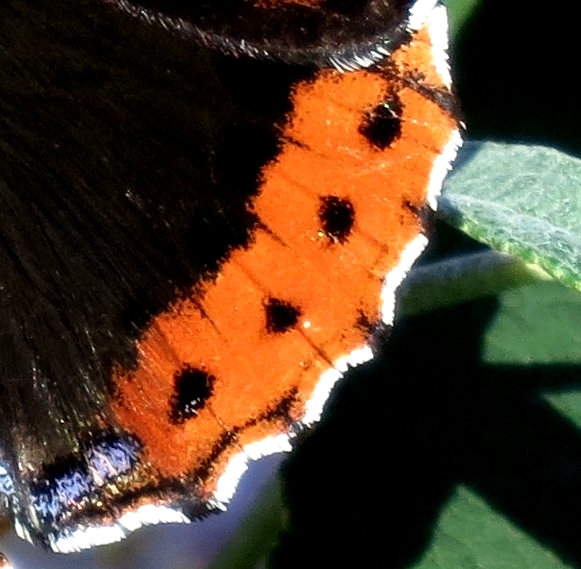
The orange curve of a back wing showing black spots, white edge and flash of blue


The edge of a back wing.

Closed wing of Red Admiral - brown with hearts and orange wavy line


A closed wing.

Profile of Red Admiral's head showing antennae


Antennae.


Proboscis of a Red Admiral plunged into the centre of a buddleia flower.


Proboscis. A Red Admiral drinking nectar.
It's why they're here.

Head of Red Admiral with eyes clearly seen.


It's looking at you!

Site Recommendation.
And in particular because it's relevant to this post, the section on Butterfly Anatomy.


(Bother. I shouldn't have told you about this site. You'll be so busy looking at it you'll never have time to visit Loose and Leafy ever again. Ah well.)

And REMEMBER  - there will be a link box for posts about urban wild plants this coming Sunday (September 21st 2014).
For more information, there's a 'Street Plant Bloggers' page. If you are not participating this time but intend to - maybe in April - let me know in the comments or email me at looseandleafy@googlemail.com and I'll add you to the list as an occasional street plant blogger.

You might also like to see a previous post on Red Admirals in early autumn. 'Ivy and the Butterflies' was posted on October 14th 2014. (I think the pictures are better there.)


Friday, 27 June 2014

NATIONAL INSECT WEEK

It's National Insect Week (23rd - 29th June 2014) - which is why all insects have gone away. On holiday, I suppose. Celebrating their smallness, their essentialness, their general interestingness. It's annoying though because I'd hoped to write you an interesting post - show some brilliant pictures - that kind of thing.

It was certainly sunny enough when I went looking. And when I went looking again. And a third time. Maybe they didn't like the cheerful breeze. Or, maybe, as I said, they'd gone on holiday. Having a special week having gone to their heads.

But I did find some.

There were masses of Swollen Thighed Beetles on white flowers. A bit small, I thought. Or maybe I remembered them wrong. Beauty expands in memory.

Swollen-thighed Beetle (Oedemera (Oedemera) nobilis) June 25th 2014 on convolvulus flower
Swollen-thighed Beetle
(Oedemera (Oedemera) nobilis)
June 25th 2014

It's hard to catch their colours. Sometimes they seem blue; a bright, iridescent blue. And at others -they look green.

Broad Centurion Fly (Chloromyia formosa) June 25th 2014 on leaf
Broad Centurion Fly
(Chloromyia formosa)
June 25th 2014

The Broad Centurion Fly really is green. Or, rather, it has a green body. Its wings are brown.

Ants farming a great, squashed-together group of black aphids June 25th 2014
Aphids and ants
June 25th 2014

Ants farming these blackfly on a broken elderberry twig are brown too. These I found specially interesting for I associate aphids with gardens, not with hedgerows. Hedgerows usually seem to hold themselves in a better, healthy balance. I'd hazard a guess this balance is disturbed when bushes and trees are trimmed back. It's only a guess though. I hope you can bear to look.

Large Skipper (Ochlodes sylvanus) June 25th 2014 on convolvulus leaf
Large Skipper
(Ochlodes sylvanus)
June 25th 2014

This Large Skipper is another matter. A beautiful orange and a pick-me-up for those of you who need to recover after being confronted with aphids! The puzzle here is why it's called a 'Large' Skipper for it's only about half an inch across.

Riband Wave Moth (Idaea aversata) June 25th 2014 caught in spider's thread
Riband Wave Moth
(Idaea aversata)
June 25th 2014

This Riband Wave Moth may have been just as beautiful when it was alive - but it's been caught in a spider's thread. (I wish spiders counted as insects because I found some interesting ones. Another time.)

There were bumble bees bent on being busy behind bramble twigs and leaves. I lurked for them a bit; then gave up. I'd already been chasing Ringlet butterflies up and down and was beginning to feel a little self-conscious. There may have been few insects but there were masses of walkers - mostly older women. Maybe National Insect Week coincides with a festival for feminine fitness for the post-sixty-fives. Some were walking in regimented hoards. No time to stop. Others were more on an amble - and a chat. It's hard to chase a butterfly and be polite.

Honey Bee (Apis mellifera) June 25th 2014 on bramble flower - with blackberry forming
Honey Bee
(Apis mellifera)
June 25th 2014

This honey bee was a bit easier to snap. It kept moving from blackberry flower to blackberry flower and not staying still even then but at least it stayed on the same bush long enough to show it was there. Imagine being able to fly on such thin wings!

Little black insect on bindweed flower
I don't know what this is.
There are masses of them in the convolvulus flowers.
Maybe there are more elsewhere - but they show up well against the white.
They are 3mm long at the most.
June 25th 2014

And there are always these little insects on bindweed. What are they? I don't know. Just little black insects who like to live in convolvulus trumpets. Cheerful creatures. (I think.)

The slogan for National Insect Week is 'Little Things that Run the World'. Maybe this little black dot is supreme ruler of us all. I nodded respectfully. Took its portrait - and moved on.

Have you spotted any insects recently?

* * *
I've found a new site that may be of interest to readers in the British Isles (and fun to browse for others). As well as other information about butterflies and great help in identifying them, it has charts of which to look for each month. Here's a link to butterflies which fly in July.

* * *
Here's the link to a previous National Insect Week post on Loose and Leafy. 'Followed Trees and Incidental Insects' (July 3rd 2012). There you can find a
Swollen-thighed Beetle -(Oedemera (Oedemera) nobilis)
Honey Bee - (Apis mellifera)
Garden Bumble Bee - (Bombus Hortorum)
Common Carder Bee - (Bombus (Thoracombus) pascuorum
Shield Bugs Mating - Palomina prasina
Darkling Beetle (Lagria hirta - I think)

* * *
With thanks, as ever, to iSpot for help with IDs.

Sunday, 20 April 2014

IF IT'S NOT ONE THING, IT'S ANOTHER

Fallen tree with trunk cut off - with mosses - in wood.
Thorncombe Woods, Dorset. April 13th 2014
Not autumn - but spring!
We'll come back to the mosses, fungi and lichens another day.
So many Tree Following posts! So many comments! It's good to see the conversations:

trees of the same kind are leafing at different times - sometimes within the same garden - why?

was Venice built on alder?

is ivy inevitably bad for a tree?

are hawthorn leaves and buds really as tasty as bread and butter?

New words - is your tree monoicous or dioicous? (Here's the Wikipedia link.)

April, for many trees, will be a month of particular change. By May - will all the snow have melted? Will blossoms have come and gone? Will southern leaves have fallen? How many bees will we have seen?

The next Tree Following link box will open at 7am (UK) time on 7th May and close 7pm (UK time) on the 14th.

* * *

Tree fallen across water, with reflections, in forest.
New Forest, Hampshire.
April 17th 2014

Since the last post I've been pottering around Thorncombe Woods in Dorset and The New Forest in Hampshire - enjoying the mosses and lichens and fungi and flowers and insects . . . and (apart from a few familiar flowers) not knowing what any of them are. Some will appear in later posts - whether identified properly or not!


SLOWLY OUT OF THE WOODS AND INTO THE LIGHT

In the meantime, I keep finding myself looking at things other than what I've set out to find.

Hawthorn Trunk - April 13th 2014


I was planning to photograph bluebells in their variety - blue, white, pink, 'native' and Spanish - but found myself looking at the bark of a hawthorn tree instead

Snail on Alexanders (Smyrnium olusatrum) - April 13th 2014


which reminded me of the shell of an ordinary snail

Aprill 11th 2014 - See the pollen sack?

and while I was looking at snails, a bee came by


I've been trying to understand how a bee puts pollen in its sack - I think it's like this . . . With its front legs it churns pollen into the air so it lands on the hairs of its back. It then licks the feet on its middle legs to make them a bit sticky, picks up the pollen with them and pops it into the sack which is attached to its back leg. Its back leg works as a pollen press, bending to squash the pollen tight so it's delivered back to the hive in the form of compressed pellets.

Bee experts - please mark my homework! Is this a right description?

April 15th 2014


Another snail


(do you see it on the Red Valerian (Centranthus ruber)) . . .

Holly Blue butterfly (Celastrina argiolus) - April 15th 2014


and near this other snail there's a Holly Blue butterfly (Celastrina argiolus) on an Alexanders plant


and not far from the butterfly, caterpillars of the Brown Tail Moth (Euproctis chrysorrhoea) recently emerged from their gossamer tent and sitting around on brambles.

Which is where things go wrong. I never delete anything from my camera; ever; in case I delete something I don't want to delete. I'm good at mistakes. But videos take a lot of space, both on the card and on my laptop so . . . having taken several videos of caterpillars going in and out of their nest, and deciding one was so interesting I kept watching it over and over . . . and having decided it was so interesting and so clear and the camera held so steady I couldn't possibly want any of the other tries - I deleted it. I suppose there's virtue in consistency. Hey ho. Never mind.

So here's what remains -  a caterpillar pottering around in the remains of its nest. (April 16th 2014)


If it's not a bluebell, it might be bark; if it's not bark, it's a snail; if it's not a snail, it's a bee; if it's not a bee, it's a flower; if it's not a flower, it's a butterfly; if it's not a butterfly, it's a moth . . . or a twig . . . or a - there's always something to see!
* * *
Links
Identify Your Bluebells (Natural History Museum - take a look in the sidebar of that page for more bluebell info.
Identify Gastropods (USA)  (The ID Tools site may be very useful to readers in the USA - and can be fascinating for those of us who live elsewhere too.)
Brown Tail Moths - This Wikipedia entry is interesting on two scores. (Probably more but there are two which stand out for me.) First - it shows what the moth itself looks like (very pretty) and says to look out for it in July and August. Second - it shows the impact the hairs of the caterpillar have on human skin. Which leads to the question - why did the woman in the picture have caterpillars wandering around on her neck? 

Thursday, 16 May 2013

THE SPECKLED WOOD'S BOTTOM

Speckled Wood Butterfly (Pararge aegeria) on leaf with wings part open.
Speckled Wood Butterfly (Parage aergeria) on Brambles
May 16th 2013
I was photographing dandelions. I couldn't stop photographing dandelions. I love dandelions.

A sign came up on my camera to say the battery was almost spent.

When a butterfly arrived.

As I chased it around, it struck me that we are a bit conventional when it comes to butterflies.

We like to see the pretty side of their wings.

Speckled Wood Butterfly (Pararge aegeria) on bramble leaf with wings closed.
Speckled Wood Butterfly - Parage aegeria
May 16th 2013

We like them to stop a moment. Even the undersides of their wings are interesting.

But, just as I showed the face of the Red Admiral in the last post. (Did you notice its curled and withdrawn proboscis?) I thought you might like to see the rear end of this Speckled Wood butterfly. (Pararge aegeria)

Speckled Wood Butterfly (Pararge aegeria) from behind.
Speckled Wood Butterfly - Parage aegeria
May 16th 2013

I wish I had such an elegant bottom!

* * *
For the UK Butterflies Speckled Wood Page - click HERE.
And to go to its page on the Learn About Butterflies site - click HERE.
The links will take you to lots of information about the Speckled Wood but perhaps I should mention here that however dramatic it looks in the pictures, this isn't a large butterfly. I doubt each wing of this individual was as much as an inch from body to tip.

Monday, 13 May 2013

IF YOU WOULD LIKE TO USE MY PICTURES - AND A RED ADMIRAL BUTTERFLY

Red Admiral butterfly (Vanessa atalanta) on gorse flowers. May 13th 2013 - Wings open.
Red Admiral butterfly (Vanessa atalanta) on gorse flowers.
May 13th 2013

I belong to a Google Circle for garden bloggers. This isn't a garden blog so I count it a privilege to have been invited to join. Over the last week, there's been an interesting and extended discussion about copyright, watermarking, meta-data etc. . . . and always in the background is the question of whether or not we are happy for our photographs to be used by others.

I've found this very helpful in re-crystallising how I feel about my own pictures and as I think it is different from many (possibly most) other bloggers, Diana Studer (of Elephant's Eye) suggested I write a post to make this clear. Good idea!

Without waffle - I will be delighted if anyone wishes to use any of the pictures on this blog as long as they are not of plants taken in an urban setting* and as long as they are not to be used for commercial purposes. (If anyone has a commercial use for any - contact me at looseandleafy@googlemail.com)

Red Admiral Butterfuly (Vanessa atalanta) on gorse flowers May 13th 2013 - Full face view showing curled and withdrawn proboscis.
Red Admiral Butterfuly (Vanessa atalanta)
on gorse flowers May 13th 2013
If you use one of my photos on your site and let me know, I will be pleased. If you link back to Loose and Leafy, I'd appreciate it but it isn't necessary and I won't be offended if you don't. However, I would definitely like you to mention it was me - Lucy Corrander - who took the photo.

Nearly all the recent photographs have been reduced in quality to help the page load quickly. If you would like me to send you a jpeg version of a picture with it's original quality maintained (so there's better detail) - I can do that. If you have a commercial purpose in mind and we agree terms of use, photos in RAW are available for most pictures from early 2012.

Red Admiral Butterfly (Vanessa atalanta) with its wings closed. On gorse flowers. May 13th 2013
Red Admiral Butterfly (Vanessa atalanta) with its wings closed.
On gorse flowers. May 13th 2013

BUT . . . and this is a really, really, really important 'but'. You must bear in mind I am not a naturalist. I try to ensure my identifications are accurate but mistakes will, inevitably, creep in from time to time. If you use any of my pictures, you must either make sure to your own satisfaction that the ID is correct, or say you can't guarantee it. AND because I have sometimes realised a mistake after uploading it to the blog, the incorrect ID may still be attached to some pictures, even if corrections have been made in the blog itself. SO it would be a good idea to check this before you use an image. If you put your cursor on a picture and right click and chose 'Inspect Element' from the drop down list, you will see details of the picture highlighted. This will generally include the date the picture was taken as well as the ID. If you have doubts - download the picture onto your computer and remove the ID, leaving the other information - image number, date, my name etc. in place. Is that ok?

None of this applies to the text on this blog - only the pictures. If you'd like to paraphrase the information, please feel free to do so - remembering to check I'm right! - but don't simply copy and paste what I've written about anything.

I suspect I will want to change the way I've said this from time to time, phrase it better. Some of you may also see that I've missed things out or been unclear . . . (mention it, please!) I'll put all this under a tab at the top of the page soon so if ever you want to refer to it - you can.

*Urban setting - those pictures which include human made things like cars, buildings, pavements, drains, street lamps, trains . . . those kinds of things.
* * *

(Hope you like the Red Admiral Butterfly! The three views are of the same individual.)

Sunday, 14 October 2012

IVY AND THE BUTTERFLIES


Ivy flower ball surrounded by leaves

Ivy flowers turning to berries
Flowers (at the back - with the stamens
(the bits that look like sticks).
The beginnings of berries at the front.
Right from when we are little, we learn to identify flowers by their petals. Children tend to draw daisies rather than roses and hardly anyone, if you handed them a pencil, would begin with a honeysuckle flower. Even now, I struggle to understand how a flower can have no petals.
Ivy Flower Buds

A petal-less flower seems more like a bud or a ready made berry. To an unscientific mind (like mine) it's bewildering. When is a flower not a flower?

Insects don't have this problem. As I noted last year, ivy flowers attract enormous numbers. This year, there are even more hoverflies (and there were a lot then!). The ivy flowers are clouded with them. Last year, blow flies (blue bottles and the like) basked on their leaves.

Red Admirals on Ivy Flowers in front of Hawthorn Berries (Haws)

At present they are not so prominent but the big surprise is Red Admirals - not that they are here (for this is an ordinary habitat for them) but their numbers. They are big butterflies, a couple of inches across when their wings are open (big for here; maybe not for the Amazon!) and they have decided to become petals for the ivy flowers. 

Red Admiral Butterfly - wings open

To human eyes, that is. They are not hanging around looking pretty on purpose. They are busy feeding. Most are getting ready to fly to Africa. AFRICA!. I'm not sure which is more bewildering - that ivy flowers have no petals or that butterflies fly to Africa. Just like many migratory birds, they mass on the south coast of England, ready for take off.
Red Admiral Butterfly - Wings Closed
The uppersides  of a Red Admiral's wings are so dramatic, they are what usually catches my attention.
Until I took these photographs, I hadn't realised how beautiful the undersides are too.
They help disguise the butterfly when it is hiding on the trunk of a tree.

What surprises butterfly experts is that some of them now over-winter here.What surprises me is that these delicate beings ever leave! In the spring, there will be Red Admirals coming the other way. Something I'm not clear about is whether any are the same individuals. I'm hoping someone reading this will know how long they live. Do you?

Red Admiral Butterfly, Ivy Flowers and Haws in front of Blue Sky

For More Information About Red Admirals

The Red Admiral page on UK Butterflies - Lots of pictures and videos (including a Red Admiral coming out of its chrysalis).
The Red Admiral Page on Adrian Hoskin's site - Learn  About Butterflies - More detailed (but very readable) information.

All photographs on this page taken 11th - 12th October 2012
For Previous Posts Loose and Leaf Posts About Ivy, click HERE


Recent Tree Following Posts

From Hollis at In the Company of Rocks and Plants
Weeping Birch

From Donna at Garden's Eye View
'Surrender'

Thursday, 30 August 2012

WHO STOLE MY LEAF?

Narrow path between elder trees - end of August 2012
Narrow path between elder trees.
To see what this was like in January click for
the first in this series of elder posts.
There are several of us bloggers who feel a bit disrupted when the council cuts verges along paths and roads. A few years ago, there was a specially deep and distressing hack-back, just when it was almost the moment to go blackberrying. It hasn't been too troubling since then. Vipers bugloss and chicory plants tend to be affected so the grassy edges of a route I often follow are less dramatic, less blue than they used to be - but the trees are kept trim without being splintered and torn; people can walk or cycle without being grabbed by brambles. It has to be done.

Until recently, the undergrowth (mainly consisting of alexanders and nettles) has been growing tall between me and my elder tree. (The 'my' meaning the one I've been following since leaves first showed their buds.) At times, it's been awkward. I've had to zoom in over the top to photograph 'my' particular leaf. And there have been irritations too - of all the leaves on the tree, 'mine' decided to be the smallest, the least grown, the runt for all that it started well.

The leaf I've been following used to be in the crook of this lichen covered bough
The leaf I've been following used to be in the crook of this lichen covered bough which
is covered in a layer of Common Orange Lichen
(Xanthoria parietina)

And now? Between going on holiday and returning, the council has been by and shaved things back. Elderberries which were ripening when I went have been cut off or shaken from their stems. And, strangely, despite having grown in the protective crook of a bough, the leaf I was following has gone, along with its brothers and sisters.

Broken branch with a piece of disturbed lichen fallen on the end


Bits of wood are broken.

Ivy leaf pierced by twig
Ivy leaf pierced by twig.


Leaves pierced.

But . . . and there are lots of good 'buts' . . . nearby, a bit of colour - 

Gatekeeper (Pyronia tithonus) butterfly on blade of grass.

a Gatekeeper Butterfly in the grass.

And blackberries too. Some have had their stems cut so the fruits have withered and dried but there are still masses ripening - not very ripe yet but there!

Blackberries ripening.

Attention will need to shift to them. They are looped over 'my' tree, even if 'my' tree is a little depleted!

* * *
This post is part of my 'Tree Following'
If you'd like to email me the link to your latest tree following post
looseandleafy@googlemail.com
(or, if you prefer, leave a link in the comments box)
I'll add it in here and make sure your name
is included in the list of 'Tree Followers' at the top of the blog.


Seeing for the First Time - Wych Elm at Patio Patch
Plane Tree - Summer 2012 at Gardening Ways

P.S. You may like this sequence of 20 pictures of  some of the world's most beautiful trees.