Until July 2017, documenting the seasons of coastal Dorset. I'm a complete amateur so don't trust I'm always right. If ever you see I'm wrong - whether with identifications or in anything else - do say! Meanwhile . . . I've now moved to Halifax in West Yorkshire. Click on the link below to collect the new URL. Don't forget to follow there!
Showing posts with label GRASS. Show all posts

Friday, 11 November 2016

GOLDEN LIGHT AT THE ASHMOLEAN

Ashmolean Museum, Oxford. Light from the courtyard spilling down some steps onto the street
The other side of Oxford; its golden light. Lots of places have golden light but if the sun happens to shine like mad in the middle of a rainy day in a place where the stones are dull and the pavements grey . . . and you  (oh so surprisingly) have your camera to hand . . . well, what do you do? You look for street plants, that's what.

I'd arranged to meet a friend outside the Ashmolean Museum but was a little early. I could have gone in - seen the Rembrandt Paintings . . the Viking Hoard . . masses of things bound to be special. A notice outside says it's the oldest museum in the country. (And of course, as we know, it's one of the best) . . .  BUT . .  if I were an exhibit, although I'd be proud to be there . . . I'd probably be a little vain by now and wouldn't be too chuffed if a scruffy woman in worn-out shoes came and stared into my eyes. And however famous I was, I reckon I'd be a little overwhelmed too. All those visitors; in-out, in-out. All day. No peace for a statue or a painting! So, respectfully, I decided to leave them alone and potter around looking for plants instead.

My world is somewhat divided into places where weed-killers are used . . . and places where they are not. The area in front of the Ashmolean must be a killing field. Could I find little seedlings between paving stones? No. Little trees up on the rooftops? No. So, having walked up and down the courtyard for a while ( 'courtyard' is probably the wrong word because it has a side missing) . . . I wandered under an arch, down a flight of steps, into the street.

By every second, the light was losing day. The clocks have already turned to winter and autumn is settling in. But an odd and brilliant shaft of golden sunlight had landed in front of the museum. Here (above) you can see what I mean. Looking back up the steps . . . you can see that tourists gathered outside the main doors are unfairly standing in summer. And for all that my socks are soggy where the rain has crept through my shoes . .  a little bit of summer is leaking down the steps onto the wet pavement and has almost reached my feet.

Leaves on paving stones (flags?) outside Ashmolean Museum, Oxford
Retrospectively, I should have gone and stood in summer and imagined it was there specially for me - but I think it was really trying to get to these particular leaves. Some leaves are . . . some leaves are . . . some leaves are as good as anything you find in a museum. I'm not turning ridiculous. If I had to chose between preserving a Rembrandt or an autumn leaf, I would, definitely, definitely, chose the Rembrandt - though with regret. Because for all that leaves are ephemeral and plentiful in a way great paintings are not, they are still absolutely and marvellously incredible. Actually . . . a leaf is more incredible than the very best, the very most beautifullest and insightful painting. It's obvious how a painting came into being (someone picked up a paintbrush and made it) a leaf just is. And if I were in a scientific mood I'd go into paroxysms of praise for its complexity. And how, when I was at school, words like 'zylem' and 'phloem' were magic. (And 'ox-bow lakes' - but that's geography.) (And 'chlorophyll' is pretty good too.)

Oh, my goodness, where am I?

Yes. So. While paintings were busily being protected in the museum . . . I was searching for plants beyond attention.

Little plants where a paving stone has broken outside the Ashmolean Museum, Oxford
Back on the terrace (better description than courtyard?) the golden light had vanished (it does!) but a few foot from the main doors; look! a cracked paving stone and a little garden!

A magnificently rebellious garden. And the most rebellious, the most defiant of all, a little grass plant in flower. See it? Oxford has it in for grass. University authorities must have arranged for armies of gardeners to keep grass under assault. There are acres and acres of lawns . . . mowed and mowed and mowed, battered into uniformity and into wearily precise, ultra-green stripes. Ne're a daisy to be seen. You can't even walk on most of the grass! What do they think grass is for if it's not for growing daisies in and picnicking on? But there you are. Back to big brains missing the point yet again - and tiny plants re-seizing their world.

Dead plant on window sill by column at Ashmolean Museum, Oxford
And, by chance . . . (it can't really be chance? more that I can't think of a reason?) - one plant on a window sill. A bit of a dead plant admittedly. But that's what most plants ultimately are - dead. It's what they eventually do - die. This one is a real mystery though. Why was it the only one there? How come other window-sills didn't have dead plants too?

And one last walk under the arch before tea at the top of the museum . . .

If you have ever wandered between state schools and public ones . . . or FE colleges and wealthy universities . .  you notice things like doors. And handrails. The more money a community has to spare, the more it has to live without interesting scratches. Being a bit of a grump-box I tend to think there are better ways to spend money on than polishing doors . . . but . . . Now. Here's a really important question. Why don't statues smile? This isn't the beginning of a joke. I really ask - why it is that citizens in public sculptures stare straight ahead or thoughtfully frown? Cherubs blow out their cheeks and grow fat. Dancing children look dizzily happy and smile past each other as if they've been drugged and frozen mid-prance.

Bust of a smiling man beyond windows in polished wooden doors.
Yet . . . under the arch . . . where the doors are polished and clean . . . looking out and smiling . . . the bust of a smiling man. Does anyone know who he is? Why he is there? Why he is smiling? I took his photograph with a wink of complicity. I doubt many people notice the garden in the broken paving stone . . . or a remnant of summer on a window-sill . . . But he and I shared something. I was looking for a world-un-noticed and he was looking un-noticed onto a world where a little bit of golden light had got itself left behind under an arch.

(Of course, he may turn out to be a mass murderer, chortling cheerfully over his crimes. Let's hope not!)

Tuesday, 21 April 2015

BACK TO BLOG - APRIL STREET PLANTS


Clump of tall dandelions by gas meter box.
People who leave dandelions to grow
outside their houses instead of weeding them away
are right to appreciate such beauty.
My laptop has come back from the menders with a new vocation.

While away it was sent back to factory settings so it's decided to dedicate its life now to incessant up-dating. Slow, slow, quick, quick, slow.

Still. It's pleasant to have a new keyboard; and for the mouse pad to work; and not to need to press the same buttons over and over before anything happens.

There are, of course, masses of things to catch up with so I'm only partly here. There are on-line bills to check, emails to send and a general gearing up. Over this non-computer period I've been doing different things and it's odd how odd it feels to be returning to normal. It's that funny kind of feeling at the end of the long summer break from school. It means you will be seeing your friends again - but affection for being on holiday lingers on.

The sun has come out to celebrate so I've been on a quick look around for plants growing in the streets.

Dandelions where playground and pavement meet
Where playgrounds meet pavements - that's a good place to look.

Dandelions come at the top of my list of favourites and, all of a sudden, there are loads of them.

White flowers and dark brown seedpods on Shepherd's Purse plant


Shepherd's Purse (Capsella bursa-pastoris) with its tiny white flowers and heart-shaped seed pods also comes pretty high on my street-plant list.

Purple leaves crossing dried earth and stone edge to pavement


Then there are the leaves of an up-and-growing Smooth Sow Thistle (Sonchus oleraceus) with a purple so astonishing it doesn't see quite 'right'. Such a colour would be a surprise in petals. But these are leaves! Leaves! (It will grow greener as it grows taller.)

Dry grass has flowered at foot of blue leg of slide


And then there is grass in its many states and varieties. I really do like the single plants which pop up through tarmac, grow beside bench legs and establish themselves between paving stones. This little lawn has already dried out and gone to seed.

Have you been noticing new plants in the streets near you?

If so, why  not post about them and put a link in the box below?

It will be good to see what you see too.

The box will be open till 7pm on the 25th April.

* * *
Apologies to everyone who's been waiting for me to reply to emails or for their trees to be added to the Tree-Following list. I'll be catching up gradually.)

Thursday, 19 February 2015

OVERWHELMED BY BEAUTY (AND A GALLANT ATTEMPT TO INSULT MY READERS FOR THE SAKE OF FILTHY LUCRE)

I have this bizarre idea that the harder anything is to find the more beautiful and interesting it will be. Naturally, this is not borne out by experience. I'm perfectly clear that if I want to see unusual plants I'd be better off in botanic gardens than in my local park where tennis courts take precedence over hot-houses.

There are some ideas which matter. If I decided to murder three people a day it would have an impact on society and it might be a good idea that I be stopped. But if I want to potter round in dull streets on dull days when it's so cold my hands are shaking with shivering and search for urban wild-plants where there seem to be none instead of heading off for places where I know there will be plenty . . . perhaps you will forgive this eccentricity. Or even recognise in it a spirit of adventure usually lacking in a road of unexceptional suburban housing, along with a spirit of genuine scientific enquiry.


My 'spirit of adventure and enquiry' seemed to have come a cropper when I went out on Wednesday lunchtime. (Sporting a woolly hat, not a topee and bare fingers because I'd left my gloves at home.) I seemed to be about to prove my theory that plants are everywhere . . . wrong.

It's happened before. I've chosen a street, marched along it brimming with confidence, found the confidence shattered by the lack of wild greenery and then . . . found it in abundance. Or if not in abundance (which it usually is) I've found some physically there.

Here's a little grassy lawn. No upkeep needed!
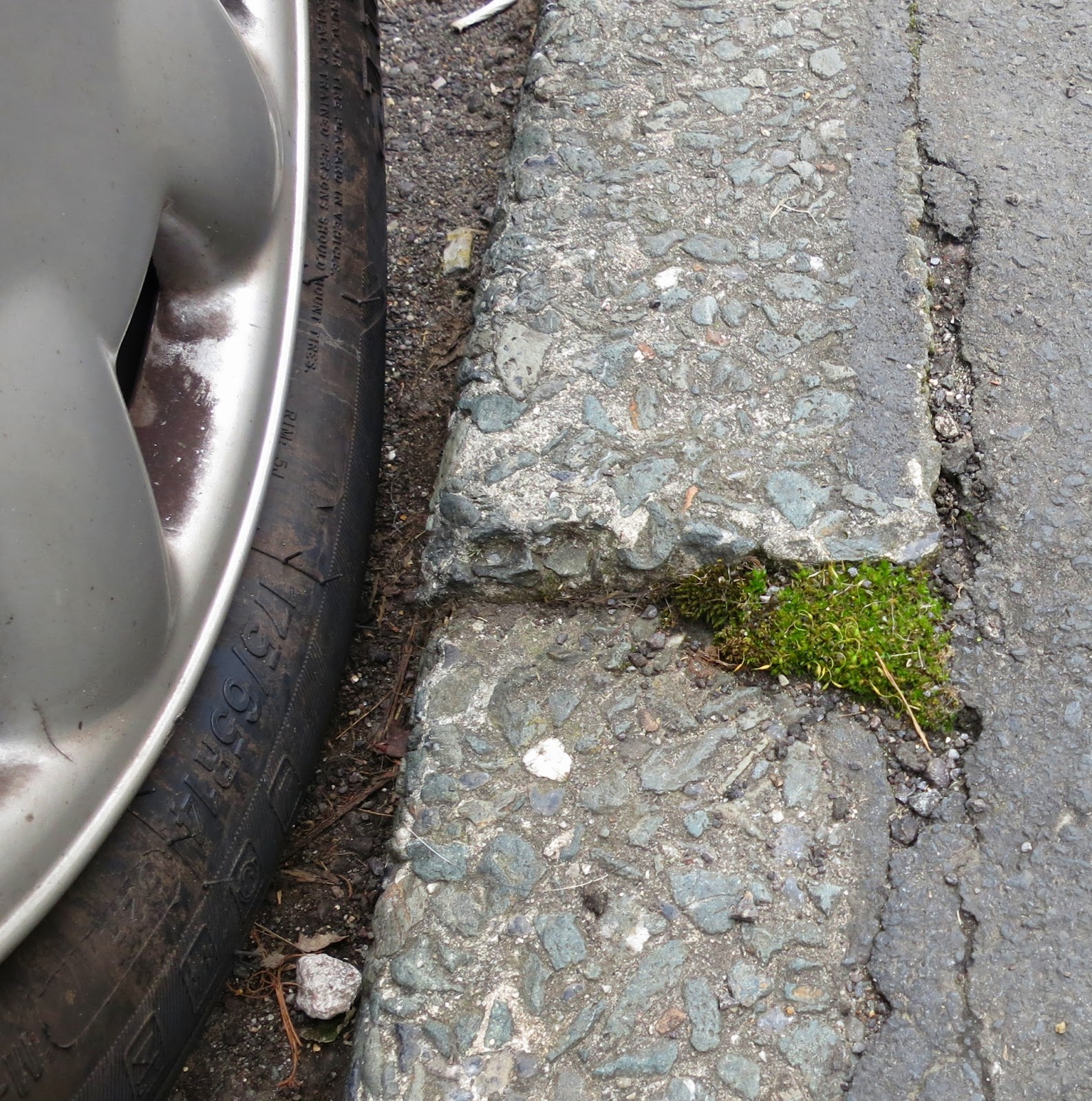
 I was already composing my post to say 'Sorry, I was wrong, February is an exception,' when I realised I was thinking too large. This was an unsheltered spot; long and straight with the wind blowing in from the side as well as up the middle. Plants which might have weathered through winter in other places hadn't managed here. The shelter I should be seeking wouldn't be beside waist-high garden walls along the path, it would be right down low in the road. In the Lilliputian / Borrowers world of small plants a kerb is a tall wall. And where cars park, the gap between the wall and tyres becomes a chasm. New motto for the coldest month 'Think Grand. But Think Small'.

And another thing. The more time that passes, the more I couldn't care less what plants are called. Their 'thereness' is what enthrals me. Really. If I were to take a photograph of a crowded street, I would expect virtually every human caught in the frame to have an interesting face. But I wouldn't rush up and down asking them for their names.

The green blob is not grass - it's a not-very-attractive patch of moss.
A prettier specimen comes later in this post.
I know, I know, I KNOW . . . we've had this out before . . . that the names of plants matter. And I KNOW that Loose and Leafy is an odd kind of blog and I probably owe it to my readers to find out what things are called so useful information can be recorded and passed on. BUT . . . er . . . I doubt many of you care two hoots either. When it comes to garden plants - that's different. If you see a good one on somebody else's blog, of course you need to know what it is so you can buy one if you would like one in your garden too. But, seriously, no-one is going to read Loose and Leafy and say 'Oh boy! Wouldn't I just like one of those little weeds to plant by my car. I must, I must, know what it is.' Of course not.

Though some . . . some are romantic. The Latin name for Common Whitlow grass is Erophila verna - which, roughly translated, means 'This plant loves spring' which is much better than naming it after a sore finger! But as it isn't yet spring in a decidedly 'sprung' sort of way, we'll have to wait for March before I start crawling around looking for that.

Not a wild plant but the head of a carnation lying in the middle of the path.
Do you know the programme 'Top Gear'? It's a programme about cars and I love it. It is extraordinarily sexist and I am a feminist - but I enjoy it just the same. It shows cars in remote and exotic places - hills, heather, mountains . . . and says they are driving around in the home-counties. And viewers are forever writing in to complain about it and point out there are no mountains in Kent or things like that. It promotes dangerously fast driving and I can't bear to be in a vehicle travelling more than about twenty miles an hour. The BBC is forever threatening to take it off the air because the three regular presenters are forever offending people (and the people who take offence may have serious, not pernickety, reasons for being offended.  . . . ). (All these 'forevers' are to emphasise how relentless the programme is in poking fun at people who might be offended. It's not an occasional slip. And it's relentless in it's never changing format too.)

I've recently come to realise how much my blog is like Top Gear. I know in advance that when I show pictures of litter here or my other blog (Message in a Milk Bottle) or fail to give proper recognition to the names of plants  - I know someone will (quite rightly) complain about litter or protest the importance of Latin. So I'm feeling rather chuffed.

Top Gear is one of the BBC's top income producing programmes (along with Dr Who) and Jeremy Clarkson (the main presenter) was reported to have earned £14 million in 2013. How's that for an example? Would it be fair to conclude the more complaints you receive the more money you'll earn? A good theory. I'm wondering if I might suggest all botanists have sore fingers . . . . and wait for the millions to role in?

Bother. I was getting so carried away with insulting you I forgot the moss on a wall. It blasted my mind. I'm dumbfounded by its colours. I keep looking at it on screen. Most of it is out of focus because I don't have the right lens for such tiny, tiny plants and my hands were shaking with cold. But you'll still see how overwhelmingly beautiful it is. Close up it's a forest of wonderfulness. Just goes to show - February (in England) is a time for looking small. (I will probably need to work harder on insulting people. Erm . . . suppose I say (block your ears if you don't want to hear this) mosses are prettier than roses . . .  will you send me a million pounds?)


Think February. Think mosses?

And if you would like to contribute a Street Plant Post to the next link box
Think 21st - 25th February

Sshhhh - some possibilities / suggestions
Top plant - Bittercress (probably Cardamine hirsuta)
The little green stars - possibly Pearlwort  (Sagina . . . um maybe Sagina subulata (Irish moss which isn't a moss!)  Or Sagina procumbens . . . ) (You see why it might be better not to bother!) )

Thursday, 28 February 2013

THE UNDERPASS - AN IRREGULAR POST

Woman hurries past railings where there are small plants at the foot of a brick wall.

It's gloomy. It's cold. Shivery cold. We wrap up and rush by. Not stopping to notice the flowers at our feet.

Busy intersection with lots of traffic lights and cars.

Everything's grey. Traffic lights about the only cheerful sight around.

The highways department - local council - county council . . . don't know! Some department . .  has planted bushes across the bridge. They are thorny and currently leafless with the remnants of red berries here and there. When trees on the left come into leaf, the atmosphere of the place will change.

Cars and lorries and buses and bikes cross the pedestrian underpass.

People walk on the slope leaded to the underpass. Plants in a raised bed at foot of bank of right.

If we want to cross, we must walk down. Past the bushes the council has put there to hold up the bank. Where ivy and teasels and cleavers and seedlings have found places to go.

In the underpass. Murals on leaf, lights on right, grass glimpsed through opening beyond.

Through the tunnel - grass at the other side.

Thistle high on the bank of grass.

Where there are thistles and things. (This picture is clickable. As well as thistles and grass and moss I've found in it buttercup and groundsel, daisies and what may be dead-nettles, a long leafed plant that might be plantain but I'm not sure. There's clover and possibly pimpernel - or maybe the beginning of cleavers. And several seedlings of something. There may be more. If you find them - say!)

A pink an white daisy with half opened flower.


There are daisies in the grass.

Single plant of grass grows from the wall beside the underpass path.
I mention  grass - but there are lots of other plants too.

And grass growing on the wall.

White and grey lichen on top of red brick wall.
This lichen may be Lecanora campestris.


Lichen too.


Close up of the lichen.


The black cushions in white cups are its 'fruiting bodies'.
Overall view of the road, the entrance to the underpass and grass where the thistle grows and daisies flower.


It may be dull. It may be February. It may be noisy and trafficy and not exactly scenic - but there's lots going on around town.


(All photos taken on 27th February 2013.)


Friday, 11 January 2013

WALKING BACK FROM THE CASTLE

Fish, Gold and Black, swimming among the Elodea crispa plants
in the pond in Sandsfoot Castle Park in Dorset, England.
Thanks to Mark and Gaz at Alternative Eden for water plant ID.
January 11th 2013

When the Castle was done up a bit last year
(and made safe to go inside)
 mats with grass on were laid along the tops of the ruins.
I don't know why. (They're falling off now.)
January 11th 2013
You know the castle in the view? The view we're following? Soon I'll show you round. First, though, I'll set up the year. Not that I've got a good record on this. I say I'll do things then never get round to them. That, or they go wrong. I decide to see what will grow in a particular patch of ground - and the council mows it. I decide to photograph the leaves of a particular tree - and forget all about them until they've not only opened but have dropped off in the autumn. Nevertheless, there are some things which are fairly well embedded in my ordinary Loose and Leafy routine. It's reassuring when we get to January to find the world is still going round much the same - at least, bits of it are! You can't stop the seasons.

Geese on the water. Portland Harbour January 11th 2013.
There's a good account of brent geese on the RSPB site.

So, imagine you are in the grounds of the castle-in-the-view. You've looked at the fish and the weed in the pond. Now you go into the castle itself (it's very small, what remains of it) and walk through it to a little platform overhanging the rocks to see what you can see. There's a lot of noise. A flock of geese (brent geese?) is landing on the water. They set off together for a very quick paddle - you can see where the water is left disturbed in their wake. The herring gulls on the rocks ignore them.


Dessicated blackberries.
January 11th 2013

Then you potter along a bit to look at the elderberry clump we've been following.  The remains of dessicated blackberries still stick out from it over the path. For much of the year, these trees are little more than climbing frames for brambles and ivy.

January 11th 2013
For all that it's a bit odd to recommend a video
about something quite this static,
if you haven't seen the Natural History Museum clip about
lichens as pollution indicators,
click HERE for Xanthoria parietina The Movie!
(And more .)
The lichen on it is a brash and ghastly orange. When it's densely packed like this . . . I'm not sure it's entirely pleasant.
Common Orange Lichen - well named! But it changes its shades; yellow one way and green the other. Sometimes it's very green - but not today; which is surprising because I've always associated the green with damp weather (and there's been almost nothing but recently!)
Xanthoria parietina is an indicator of nitrogen in the atmosphere too. Near the sea, as this is, nitrogen is to be expected. (Sea birds contribute a lot!)

Common Orange Lichen
(Xanthoria parietina)
January 11th 2013


The first picture shows its real colour on January 11th 2013. This is the same photo with the colours changed a bit to emphasise their gradations. (So you notice the bits which are a bit greener. Sometimes, they are greener still.)

Elderberry.
January 11th 2013


The elderberry leaf shoot we've been following for more than a year (!) and which did hardly anything last summer . . . .  There's a new leaf where the old one was. It's got a sort of head-start in height this time round. Maybe it will one day become a branch? This appears to be a long term project!

Ivy Berries
January 11th 2013

The year before last, I followed ivy until its berries ripened but never showed you what happened when they opened and dropped their seeds - so we'll take up with ivy roughly where we stopped off before. For all that it's a common plant, its flowers, berries - even the shapes of its leaves - go much un-noticed. I suspect its seeds are even more of a mystery. (See the post for December 3rd 2011 -  Exploding Ivy and for January 13th 2012 - The Berries Mature.)

Cock's Foot Grass (Dactylis glomerata) January 11th 2013

Grasses - I'm thinking it might be a good idea to make more of a fuss of grasses this year. Grass isn't just grass it's . . . well, here's some flowering already.

And the view.

The view we're following - with Sandsfoot Castle and tree.
January 11th 2013

I'm a little fed up with this view. It never does much except sit there and be beautiful. And I daren't go back to the dent where the willows are to look at the rocks because the cliffs have been so washed by rain recently I'm worried they'll slip down and squash anyone who goes too close.

So I'll pretend I've been back, even though I haven't, and put in a picture I took there before . . .

December 18th 2013

Shells emerging from one of the rocks in the dent. Prehistoric cockles? (Anyone know?)

* * *

January 11th 2013

Some tree followers have been rounding up their year with final posts about their particular tree. I'll soon do a round up of the round ups. Have you finished with your tree or will you be carrying on? Has it been interesting? Will you be choosing a new one?

This, as you can see, is the one in the foreground of my view. I'll be specially aware of it over the next few months because, by summer, it will be obscuring what's beyond - and, by then, the brent geese will have gone.

* * *
Best wishes for 2013
I hope your year has got off to a good start.

Saturday, 30 July 2011

THE ONES THAT GOT AWAY

I've been invited to go on a trek. My neighbour, Esther Montgomery, has suggested I go on a camping holiday, travelling due North through England and Scotland and coming back on the other side (more or less). There will be Esther, her husband, their two children . . . and me! You can see the route plan on her blog - here.

How can one resist? The down-side is that I won't be able to blog while we are gone and, by the time we return, the season will be turning and pictures I have been accumulating for particular posts will have become dated and irrelevant. That's the trouble with a plant blog - you can't put nature on hold!

But I don't want to abandon some of these topics so here are some pictures that were intended for a couple of urban posts.

First, plants which grow along the edge of the pavement and the drop into the water of Weymouth Harbour. 

In the foreground is the edge of the pavement. The concrete path beyond it is a pontoon where boats moor while waiting for the bridge to lift so they can get into the inner harbour without having their masts lopped! Beyond that is the water of the harbour itself.

It always astonishes me that plants can grow (and flower!) in such inhospitable places. There's no visible earth. There's traffic on one side, boats on the other. (The engines of some boats can be very fumey when they are start up and turn towards the sea.) The wind can be strong along here and there's salt in the air.

The blue is a pipe going down from a tap. You can see the tap itself on my other blog-
Message in a Milk Bottle - TAP.

Is there anywhere Buddleia will not grow?

Where plants have no hold - moss takes its chance.

And, down in the gap . . . a leaf floats by.

Below the life-belt case .

* * *
I had an inland-urban post in line too. Pavements made from bricks have become common - and plants are glad of the cracks between them.

Never under-estimate grass!

Some ubiquitous plants don't like to be trodden on.

There can be great variety at the foot of a wall where residents refuse to 'weed'.

Grasses come in many forms. Hurray!

Don't forget to look close-up! The patterns and textures can be impressive.

* * *
Alright, I know that, however impressed I am that so many plants are able to get their feet into almost impossible places

 . . .  most who read Loose and Leafy like to see colour and countryside. Here is a picture which got away when I wrote the post about the under-side of flowers.

I'll be back in September . . . around the 16th I expect.

Have a good August everyone.

Lucy