Until July 2017, documenting the seasons of coastal Dorset. I'm a complete amateur so don't trust I'm always right. If ever you see I'm wrong - whether with identifications or in anything else - do say! Meanwhile . . . I've now moved to Halifax in West Yorkshire. Click on the link below to collect the new URL. Don't forget to follow there!
Showing posts with label SEA. Show all posts

Thursday, 30 March 2017

THE DAY I LOST MY NERVE

On the tops of the cliffs at Burton Bradstock there are sheep fields with dry stone walls.
This morning I emailed a friend to say I was about to walk beside the Broadchurch cliffs near Burton Bradstock.

Quick fire he replied; he'd be frightened to go to the Broadchurch Cliffs but for someone living in Midsommer it would probably feel like a holiday.

Explanations.

The cliffs along the short stretch of Dorset Coast between Burton Bradstock and West Bay are integral to the plot of the television drama 'Broadchurch'. They loom over it. They set the atmosphere.

In the first series a boy's body is found beneath them. (Not a spoiler - the start of the story.) I'm not sure what happened in the second series because it was all a bit of a blur - so very much overloaded with events and surprises it's forgettable; all but the scenery. - the scenery can never be ignored. We're into the third and final series now. It's about rape. It's not cheerful TV. The music is drone. It never lets up. The action is slow. Little happens. But it's well plotted and well acted so each hour-long episode flies as fast as twenty minutes. (Come to think of it, there are three advert breaks in each so it probably is only twenty minutes.)

Midsommer Murders is a long-running detective series set in rural Oxfordshire. There are so many people murdered in every episode it's a standing joke there's anyone left to kill. For the residents of Midsommer, one dead boy is nothing. (They are different genres.)

That's all fiction.
What is not fiction is that these cliffs are terrifying.
They are so terrifying I didn't take any photos.
I didn't walk beside them.
I didn't walk beneath them.
I ran away.

The sea was magnificent.
The waves were enormous.
The roar was exciting.
There was a small crowd of people waiting for the tide to turn so there would be enough safe space between cliffs and water wide enough to pass through safely.

I was terrified. It wasn't just that the cliffs might crumble (which they might) . . . I couldn't stand the feeling of being loomed over. Nature-bloggers aren't supposed to scream inside and flee from their subject matter. But these cliffs are big and red and cracked and gold and they ripple like tall curtains from sky to beach.

I don't like them.
(Shame you can't see them!)

Fortunately, cliffs have grassy tops as well as pebbly bottoms so I walked along up high instead - where there were gulls and fulmars and larks and crows and sunshine and drizzle.

Of course these tops are the earth and rocks which would fall to the beach if the cliffs were to crack, so the choice was not between living and dying but between being crushed by hundreds of tons of rubble or being part of the rubble hurtling down. But light is good. And it's reassuring to imagine one might be able to leap fast enough to cross an unfolding chasm and run inland if necessary. (Through the sheep-field.)

I didn't walk far. When I reached the mouth of the River Bride, I turned back. Rain threatened. 

If I could have turned it into a sunny day for you, I would have.
The River Bride is a pretty little river - and pretty creepy too. Here, as it fights its way into the sea, it carves the most extraordinary shapes. (Its birth at Little Bredy, six miles inland, is the setting for the first Broadchurch rape.)

Dorset is a weird county. It's one of the most beautiful places on earth yet the fiction it inspires is cruel.

Take Thomas Hardy. He wasn't exactly a barrel of laughs.
Mayor of Casterbridge - a drunken man sells his wife to a stranger.
The Trumpet Major - a young woman is sexually harassed by the nephew of the local squire. 
Tess of the d'Urbervilles - a young woman is raped, her baby dies, there are all sorts of complications, she eventually kills her 'seducer' and is executed.

Because I didn't walk below the cliffs I can only show you views from the top!
I had a nice walk though.

P.S. If this were a literary blog I would be wanting to know why there's a cheerful picture of someone hanging out washing on the front cover of Tess of the d'Ubervilles and how come Penguin can describe The Trumpet Major as 'Lyrical and lighthearted'.

The links between literature, landscape and sorrow can be pretty weird.
Humans are weird.
Wouldn't you say?

P.P.S. Readers who've never visited these cliffs may be disappointed there's no picture to show what it's like to look up at them. I just say they frighten me because they loom and might fall over. . . . So I suppose I'll have to go back soon and have another bash at being brave. Not brave for long, you understand. Just brave enough to aim my camera at their stark and dark and rippled faces - before running.

Sunday, 23 October 2016

DORSET

The sea at dusk; West Bexington, Dorset
West Bexington, Dorset
I was recently in Halifax. I'd not been before. And I was eating out. Something I rarely do.

The front of house staff seemed all to be university students and I wondered how far they'd had to travel to get to work. But the young man assigned to our table was still (surprisingly) at school - and assiduous in making sure we were happy with our food and happily chatty. We asked him what it's like to live in Halifax. It didn't sound wildly exciting - simply a pleasant place to live. We asked about town centre violence. He didn't seem to think there was any; though it sometimes gets a bit crowded, he said, outside the only late-opening chip shop.

Looking down on Chideock, Dorset
He asked about Dorset.

Well, we had to admit, you need to be careful when you go into Weymouth. There are fights. There are knives. There are drugs. It's a great seaside town; a popular holiday destination. But people get drunk when it's dark. (And earlier.) They can be noisy and querulous.

Conical hill, ploughed field and sea taken from the path up to Golden Cap, Dorset
Looking across ploughed fields in shadow on the way up to Golden Cap, Dorset
But apart from that . . . Well, it's stereotypical English countryside only more dramatic: huge hills with soft grass; green valleys, sheep, cows, thatched roofs, cottages, cliffs and the sea.

Rural England has other stereotypes; calendar images of Essex, Sussex and Kent: village ponds and windmills and interesting Churches. They are all accurate. As are half timbered walls, bricks and flint. Then there's Stone Henge in Wiltshire. (But the plains of England are largely ignored.)

And there's London. Hm. London. London is London. It's not exactly 'England'.

South coast cliffs, the sea and an autumn hedgerow on the way up to Golden Cap, Dorset
Path and Cliffs from Golden Cap, Dorset
Talking with our waiter, I was a little embarrassed. Yorkshire covers a huge huge area of England. It's a strapping great band going from almost-the-sea in the West to the North Sea in the East. In the North and West there are tremendous hills, almost un-scalable. And plains which seem to go on for ever in the East. But for all that, I don't think these are the areas people in other parts of the world will first think of when they hear the word 'England'. It's odd. Because when we sing 'Jerusalem' (oh so very 'English'!) it's the hills and mills of places like Yorkshire we have in mind.

Cliffs and sea. Looking East from the top of Golden Cap, Dorset.
View East from the top of Golden Cap - the tallest cliff  on the South Coast of England. Dorset
In Halifax there are the skeletons of massive mills, a tangle of motorway style bridges and roundabouts, but no thatched cottages.  I'm used to looking out over great expanses of water. Halifax has reservoirs dotted around its outskirts but it doesn't have the sea. It doesn't even have a river.

If you are keen on water . . . In Todmorden (only a few miles west of Halifax) a woman told me it's not so much that you need to like rain to live there but that you have to enjoy swimming through air. And as last winter's floods showed - sometimes you'll find yourself wading up streets.

Pools of sunlight on the sea between Abbotsbury and Bridport, Dorset
Pools of light on the sea.
Taken from the road between Abbotsbury and Bridport in Dorset.
This is daytime and the photo is in colour.
Sometimes the sun is so bright neither your eyes nor your camera can accommodate
the Mediterranean blue of the English Channel here.

I like Halifax. Though I took no photos. (Another time!) Halifax has masses that our part of Dorset lacks. But being asked what Dorset is like . . .  I thought of the sea and the rivers and the cliffs and the hills . . . and for all that there's no-where like Yorkshire . . . there's no-where like Dorset either. And the thing about Dorset, as I've said before, hardly anyone knows it's here.

Sunday, 29 November 2015

IT'S WINTER HERE

Man on Chesil Beach looks out to sea.
I've nearly gone. There was to be another book review before the sleep-tight round up but I decided if I couldn't say anything nice about it, it would be pointless even to mention. So now I need the wind to calm and the sun to come out so I can trot around with my camera to say a temporary 'Goodbye' to the plants and trees and streets which form the subject matter for this blog.

But I can't let you miss today.

This was here at mid-day. It's not a sea to swim in, to paddle in or to surf in. It's a sea to die in. You go too close at your peril.

This man is not as close as he seems. Chesil Beach goes down in steps so although it looks as though he is standing at the edge of the surf, he isn't. The sea is below him - which may give you an idea of the size of these waves.

There were lots of people. By 'lots' I suppose at any one time there were a dozen. But they were coming and going - and virtually every one of them with a camera. I have not done justice to this sea - but the air was dense with salt and spray. It was reckless. Cameras don't like salt and spray. But I wasn't the only one who couldn't resist it. (Camera menders may be in for a bonanza!)

Incidentally, the black blodge on the waves is a huge mat of seaweed.

Thursday, 17 September 2015

ONE YELLOW FLOWER AND THE SOUND OF WIND AND SEA

Yellow flower with sea beyond.
In theory, I'd gone to look for a Stuck Foot Post. In practice I came back with nothing but one yellow flower.

I liked this flower so much I thought I'd give it a post of its own.

But I'd also taken a standing-still video for the sake of listening to the sea. Back home I noticed this yellow flower is part of 'the scene' and as it thus plays a supporting role decided to add the sound (and minimal movement) to the post.

The video was set to 'poor'; and as it was supposed to be for a Stuck Foot Post it's a bit wobbly towards the end - I couldn't twist as far as I'd hoped while keeping my feet glued to the path!


If you are receiving this post by email, 
you might need this link 
to view / listen to the video.
Hey ho!
The next link box for Stuck Foot Posts will be open between the 21st and 25th of September.

Tuesday, 31 January 2012

ROUND A ROCK

This morning, it was cold; very cold. The frost was patchy but, when I went down to the sea at around twenty to ten, it was . . . finger chilling cold.


But the light was lovely.


I would usually aim for a little more variety in a post than there will be in this - but I fell in love with the colour and texture of seaweed on one rock.


I've been scrolling through these pictures over and over. I should get bored because they are all of the same thing. But I don't. I don't know why - I just don't!


I hope you like it too.


This little pool on the top of the rock is about two inches across.


And this is the next rock along. Same seaweed - different arrangement; a sort of skirt round the bottom!


While behind me - is the sea; with three Brent Geese swimming in the path of the sun.

I'd like to have taken the rocks home with me. I'd like to have taken the sea!

(But I think I'll need a little more in the way of storage before I'll try that! Indeed, I'd need a world full of garden sheds!)

This post is supported by Argos.

Saturday, 19 November 2011

WALKING INTO THE BLUE

There's a little path I like. It goes down to a little beach - and I often go there. You've been with me before. It takes about one and a half minutes to walk down and the same coming back - probably less- yet the undergrowth is so dense and varied, I could write a post a week about this one short stretch and there would still be more to see.

This is a little of what I saw on 17th November 2011.


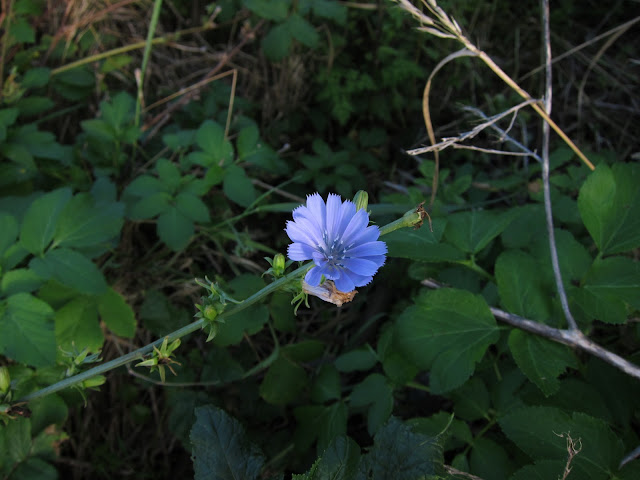
At the top of the path - Chicory Flowers.

A few years ago, I complained to our local council that it cut back blackberry bushes when fruit was on them - and, at the same time, raised questions about the spring trim in relation to nesting birds. I don't claim it was my email alone which got it changed. Indeed, it may have had absolutely nothing to do with it but, since then, the autumn tidy has happened later - and they've just done it so only the shorter chicory plants are still standing. They've had a bit of a tough time this year because the spring trim happened immediately after the first were tall. They are one of my favourite plants so I was pleased when others grew to replace them. I will miss the tall white stems they would have left through the winter if they'd been left uncut but there's no point in a path if you can't walk along it!


Summer here lasts long - right into autumn. Here's a Viper's Bugloss plant. It too has been cut. It has to be done - but look it was still in flower when it fell!

Also at the top of the path - a small maple. (You'll know from previous posts that I'm no good at distinguishing trees in this group so you may say "No! It's a sycamore!" or . . .) (I hope you won't pop up and say no! It's rhubarb!)

The light is uncertain. It flickers between sun and no-sun. The sea is impressive whatever the weather but, since this post is called 'Walking into the Blue', let's choose a sunny moment.

It's evening in mid-November so the sun is low and there's a glare on the water. It's also the time of year when seaweed washes up in bunches.

Back up the path and, caught in the blackberries (you could cut them back for a million miles and we wouldn't run out of blackberries!)  . . . keys from the maple / sycamore / (or even rhubarb!).


Autumn.

Saturday, 17 September 2011

HOME IS WHERE WE KNOW

When we set off for our exploration of England and Scotland, I'd imagined I'd come home with lots of photographs of plants.

I didn't.

It rained. My, did it rain! You know the myth about people who live in snow-filled worlds having an almost infinite supply of words to describe the consistencies of snow? I now wish I had words for rain. Never previously have I realised how many kinds of rain there are. Some are beautiful. Some are as hackneyed as buckets of water thrown into the set of a B movie. But through all the kinds of rain we travelled, never did I find one which would make friends with my camera.

There were other disincentives too. Telling the people one is travelling with (Esther Montgomery and her family) to stop posing for holiday snaps and get out of the way of a leaf - isn't friendly. Nor is expecting them to wait while you crawl through the undergrowth. But these are not the only reasons for my empty handedness. Nor are they the most interesting. For I have learnt the value and importance of familiarity.

August 8th 2011

This is one wonderful landscapes we found ourselves walking in while we were away - part of the Goyt Valley in Derbyshire.

Fortuneswell (Dorset) Portland Harbour, Chesil Beach and The Ridgeway.

This is what I am used to.

Standing where I stood to take this photo, I am close to the Young Offenders' Prison, the stone quarries and the Old Railway Line I described in THIS post. The great bank of pebbles stretching into the distance (Chesil Beach) is pictured in THIS one. Most of the hedgerows featured in this blog are straight ahead. I live in an especially plant-rich environment - but people who live in the hills and the moors would say the same of the land around their homes - for they know what they are looking for.

If it hadn't rained so much, I would have learnt what to see. As it is - I re-learned the value of 'home'. Context is crucial. Familiarity opens our eyes.

August 8th 2011
This is the tent we travelled with - set up on Cold Springs Farm, right next to the Goyt Valley (pictured above).

Here are the plants we came home to.


The ripened sloes.


Little yellow daisy flowers. (The blue dots are the remains of Vipers Bugloss, still not quite over.)


The seed of Alexanders. (Which, to my embarrassment, I used to think belonged to Ground Elder.)


Brambles and willow herbs.


Seaweeds.


Fossils which emerge from the rocks, almost as I watch.


And the sea, the sea, the wonderful sea. It's the Isle of Portland, straight ahead. (I was standing on the highest point you can see here when I took the second photo of this post. If I had still been there, and had binoculars, I could have waved to myself.)

I'll show you more from our adventures as the weeks go by. But first, I celebrate 'home'.

(All local photographs were taken today, September 17th 2011.)

Esther's posted about one of the places we visited while we were away - Little Moreton Hall in Cheshire - HERE.