Until July 2017, documenting the seasons of coastal Dorset. I'm a complete amateur so don't trust I'm always right. If ever you see I'm wrong - whether with identifications or in anything else - do say! Meanwhile . . . I've now moved to Halifax in West Yorkshire. Click on the link below to collect the new URL. Don't forget to follow there!
Showing posts with label FESTIVALS. Show all posts

Friday, 11 March 2011

FROM SMALL SYCAMORE SEEDS . . .

Not a lot of change at the tree. The lesser celandines between its toes have been nibbled to their stalks. At the foot of the bank, the dip is dry. When rain comes it will be soggy. Sometimes it's a sluggish small stream. The patches of green down there are celandine leaves - not enough to impress though. Meanwhile, the bluebells on the left of the picture (hope they are bluebells! - time will tell) are bulking up.

March 8th 2011
February 9th 2011 - in colour!

The sky has changed. Not all the time - but when I took the latest pictures (8th March 2011) it was blue.


This is the view of the bank opposite, from beside the tree. The sky might be blue but the light is cold. (The shadow on the path is of the next tree along, not the one we are observing. It too is a sycamore.)


At my feet, a clump of moss; a marker so I know where to stand next time.

And on the moss, a sycamore seed. Already it has a root boring into the earth. With this anchored, it begins to wrench its head from the wing.

The parent trees remain leafless while their offspring need light for first shoots.


My breath is taken.
the

This post is for THE TREE YEAR, 2011


Wednesday, 9 February 2011

THE WOODLAND TREE WITH PLANTS AT ITS FEET

I sometimes wonder if I am the most boring person I know. Each year, I look at the same trees, the same patches of mud, the same plants, the same twigs - precisely the same twigs if they are still there which, sometimes, they aren’t.

Each year, I announce grandly that I will follow one of these familiar things right through the season, only to find they are chopped down, trodden on or done in by the weather.

Last year, I chose a tree and took photos of the plants around it. The year before, the whole area, had been plastered with Lesser Celandines (Ranunculus ficaria) in the spring. I was expecting to show you the ground as it turned yellow with bright, starry flowers. No. There was drought and the bank stayed brown and dull right through the summer and not in the least bit interesting to document because hardly anything changed. There certainly wasn’t an outburst of yellow flowers.

I went back today.

Considering the amount of rain we have had recently, the ground was surprisingly firm - so, maybe this will be another non-celandine season. Undaunted - and at the risk of you confirming that I am the most boring person on the internet . . . I’ve re-photoed the tree and the plants immediately around it. At the very least (I hope!) the tree will grow leaves!

Here, then, is the context; a bank beside a path which has been built along an old railway line. The tree is second on the left.


This one.

A sycamore with bare branches.


Ivy on the trunk.


Bluebells near it.

Arum maculatum tucked between its toes.


These are on the opposite bank but show how the plant unfurls. As the season goes by they will produce pale curving flowers (like unrolling pages) (one each) and, by autumn, these will have been replaced by pillars of bright red berries sticking up through their middles.


And the jolly old Lesser Celandines (Ranunculus ficaria).

Flower plants, flower!


This post is for Festival of the Trees Number 57.

Festival of the Trees
Number 57

Friday, 14 January 2011

SILHOUETTES

Blackthorn - Prunus spinosa
If I tell you right at the beginning that all pictures in this post are in colour, you may understand why there haven’t been as many as usual and why Message in a Milk Bottle is suspended until better light.

It’s not just that the skies are solid and dark - but it now rains almost every day too and my camera objects to water. It’s raining hard as I write.  Sometimes, it reduces to a drizzle and sometimes it stops for a few minutes - then it starts again. Even in those few moments, there are spits in the air.


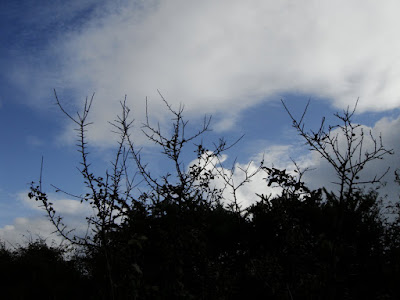
Blackthorn is more noticeable
when it comes into flower.
After that, it seems to vanish until its fruits appear (sloes).
I think it is specially beautiful before anything happens.


Gorse - Ulex europaeus

Underfoot, the earth has gone mushy and some plants seem to be dissolving. Hedgerows appear to be faring better than gardens and there is, in both, a greening. I was planning to put some examples here - of the lichen which was yellow but which now isn’t and a little plantain seedling (Plantago lanceolata (Ribwort) not an exotic tree like Musa balbisiana, with fruits that look like bananas. Despite the daily rise in temperature and the almost constant rain, we haven't (yet) gone tropical!).


Alexanders - Smyrnium olusatrum

But, when I included photos with too much green in, they looked out of place. It's as if there are parallel worlds - one (at foot level) where plants continue to grow and another where everything is apparently static - still in waiting. In my last post, I looked mostly down, where the growth is. In this, I'm risking turning the lens up (quick up, quick down before the view goes fuzzy and the rain leaks in) where branches and dead leaves, shrivelled fruits and desiccated plants make wonderful silhouettes against the annoying and constant grey.


I'm pretty certain this is
Chicory - Chicorium intybus.
Winter has given it a soggy
brown texture and mush
where its seeds were.


For the bushes, trees and last season's plants are still worth looking at. Detail is gone - but their silhouettes are specially lovely. I’m putting a few here. There are more to come for they are so delicate, so lovely, bombarding you with a hedgerow full in one go would be too rich a feast.


A post for Skywatch.

Thursday, 22 October 2009

UP AND OVER - AN AMBLE WITH IGNORANCE (Janet and John have nothing on this!)

.
It's been a long gap.
.
I've been doing other things with my time.
.
I've been thinking I should know more.
.
Why?
.
I'll never know enough. Why suddenly let ignorance get in the way? S0, this morning I went for a walk up the slope - past my old friend the blackthorn - see the silhouettes of sloes?
.
.
.

.
.
And past the Old Man's Beard (Wild Clematis.)
.
.
.
.
.
Then I went down a little path to the sea.
.
.
.
.
Here comes the ignorance bit for, beside the path was a plant with leaves that look like scented geranium and yellow, daisy-like flowers. I don't know its Latin Name. I don't even know its common name. But why should that hold me back?
.
(Linda at Garden Girl has left a comment in which she suggests this yellow flowering plant is Golden Marguerite (Anthemis Tinctoria). She says, too, that she once had some in her garden. It strikes me, quite frequently, that there's a kind of living archaeology to be found in the hedgerows - hints of what used to be there. There'll be a post on that sometime!
On the other hand . . . VP suggests it is part of the Senecio (Ragwort) family. If so . . . which kind of Ragwort might it be . . . anyone?)
.
That was on the ground, on the left.
.
.
.
.
This was the view to my right.
Mostly Blackberries but not bad, eh?
.
.
.
And at the bottom of the path . . .
.
.
.
.
Reeds . . . and the sea!
.
.
.
.
.
.
.
.
.
Looking right . . .
.
.
.
.
.
.
And where the cliff touches the beach . . . a little plant of green leaves.
.
(Not the right technical language? If anyone tells me it's name, I'll put it in.)
.
(The photo is upside down. I put it upside down on purpose because it looks odd the right way up. One expects grass to stand up straight but it was hanging long and limp.)
.
.
.
.
.
.
And back by the reeds . . . these . . .
.
.
.
.
.
.
.
.
.
And this when I look left and not right. Those are the cliffs and hills of Purbeck in the distance. No boats. Well, not many. Most have been hoisted out of the sea by crane during the last week. Now they are neatly parked for the winter in the sailing club grounds. (Will people who are interested in plants please pay attention to the grass?)

.
And here are the boats - boats in blue coats for the winter.
.
See?
.
(It's a bit like 'Janet and John', this! Hope it's alright!)
.
.
.
.
.
.
Then up the bank . . .


.
.
.


.
.
And over the top to the teasles.
Who looked at the plants?
Who looked at the sky?
Me?
I can't keep my eyes off the sea!
(None the less I've linked to Skywatch!)