Until July 2017, documenting the seasons of coastal Dorset. I'm a complete amateur so don't trust I'm always right. If ever you see I'm wrong - whether with identifications or in anything else - do say! Meanwhile . . . I've now moved to Halifax in West Yorkshire. Click on the link below to collect the new URL. Don't forget to follow there!
Showing posts with label STREET PLANT POSTS. Show all posts

Tuesday, 9 May 2017

RIBWORT - A GARDENING SUGGESTION (Plantago lanceolata)

Ribwort Plantain leaves beside tarmac path.
The last few days have been dry -
and this plant is feeling a bit old.
Many plants droop a bit when their flowers are turning to seed.
(It was in shade when I went to take it's picture before.)
You know how beautiful dandelions are yet how few people let them into their gardens? Well, in addition to praising dandelions I'd like to recommend Ribwort . . . or Ribwort Plantain . . or Plantago lanceolata if you want to be posh about it, as a delightful garden flower.

It's only recently that I've noticed how wonderful each individual Ribwort plant is. It has shape and poise. It's usually buried in grass but with space around it . .  well, why doesn't everyone have one?

Upright head of Ribwort Plantain beside small holly tree in street.
Like Hollyhocks and Foxgloves,
the flowers work their way upwards so you get to see the seeds forming,
the white stamens with their prominent anthers and the un-opened bits all on the same stem.
I grew a nettle once. It was in a pot and it looked magnificent. In a pot it couldn't spread. In a pot each leaf could be seen distinctly with its beautiful crisp and distinctly ziggy-zaggy borders.

Now I'd like to recommend Ribwort as a plant to grow at the edge of a flower border - with plenty of space around it so its flowers and seed heads can lean elegantly and its leaves stand erect or splay around as they please. Daffodils - well, their flowers are wonderful but their leaves have little to commend them. And as for shape - well, they are nothing but stalks with trumpets on top. Ribwort, in contrast, is a plant of completeness. You wouldn't want to put its flowers in a vase and you wouldn't want to pick its leaves to pad out a display . . . but you might want to stand back and admire it on its own, where it is and with all its elements intact. Like a beautiful human. The person you most admire might have fantastic arms but you are unlikely to want to cut one off and use it as a centre-piece for your dinner party table. Some things just aren't the same when cut off.

Compact head of Ribwort Plantain with yellow flowers behind.
Photos in this post come from plants round the corner from each other.
This one has short and compact heads.
I walked backwards and forwards between the plants to see what other differences there are.
The one with the compact head has narrower leaves.
Someone will no doubt be able to say why.
Something going wrong with precise identification?
Age of plant?
Location?
In this picture you can clearly see the 'ribs' on the stem where a head has been broken off.
I decided on the idea that Ribwort Plantains are worthy of a place in our gardens when planning a Street Plant Post. There were a few, flat, broadleaved plantains in the gutters but the lanceolot type were on the edges of little patches of ground in front of houses. They must have arrived inadvertently and either been ignored or taken to heart as regular front-of-garden flowers.
One of the things I find difficult about Street Plant Posts is that it's sometimes hard to get a good angle on plants without including number plates so although I came across a Ribwort Plant growing on its own through pebbles, with a space cleared around it so its full shape could be seen - well, I would have felt too intrusive to have taken its picture. Plants in the gutter aren't too bad to take photos of (as long as you don't get your legs run over.

Ribwort head showing ribs on stem - with tarmac background
The result, then, is that for all that I'm commending it to you, I can't show it to its best advantage. However, of all the photos on this post, this is my favourite and I'm currently using it as my desktop picture. (You can try it if you like.)

I'm not sure how easy it is to grow from seed but for many of us in the UK it's easy to come across so it's worth a try.

As for proper information . . . anything I could say would simply re-hash what can be read on the internet so I'll offer some links rather than waffle about and pretend I know more than I do!

I'll begin with a link to a Wikipedia Page. It's a Glossary of Leaf Morphology which, being interpreted, means a list of the names of shapes of leaves with pictures drawn and descriptions written. It's brilliant. It's a browsing page. Find 'lanceolate' on the chart and you'll see where Ribwort gets its lanceolata from. Even if you aren't won over to Ribwort as a special garden plant, you may well be enchanted by this link.

Ribwort head with frill of flowers at bottom.
I'm really annoyed that I haven't been able to take
a photo of a plant free-standing without number-plates and people included.
And there's only one picture with leaves.
But don't you think the colours are amazing?
That bluey-black at the top?
This head is about an inch long.
And the stem is twenty-four inches. I measured it!
The rest of these links go to Ribwort Plantain Pages on nature sites with more to them than Ribwort so if you have time, you might like to go on an explore.

Wild Flower Guide - Look for Ribwort Plantain in the index down the right hand side. 'Plantain Family' is another interesting one to click.
Nature Gate
Easy Wildflowers
Garden Organic
Emorsgate Seeds - someone actually sells Ribwort seeds!
Nature Spot
The Wildlife Trusts


* * *
And completely irrelevantly - Butterfly Conservation is raising money by inviting you to take part in an auction to sponsor a moth species and have your name printed with it in The Atlas of Britain and Ireland's Larger Moths. Whether or not you'd like to be a moth benefactor, do take a look at this site because the photos of the moths in their 'auction' (it's alright, they're not selling dead and dusty creatures on tall pins) are delightful.
* * *

P.S. It seems to me that the more boring a flower looks, the more complicated it is to understand. (I struggle with ivy). While trying to understand the flowers on a Ribwort Plantain Spike I found a page in Google Books where Macgregor Skene (in the 'Biology of Flowering Plants') explains that the stigma are produced from flowers in the upper part of the spike while the stamens hang from the lower. This is in relation to wind-pollination.
One of the troubles with wind is that it makes plants wobble so my photos aren't good enough to peer into to see what this looks like . . . however . . .  wandering off at a tangent to find out about the book itself I found this interesting and honest explanation on Amazon about the problems in re-producing a book originally published before 1923. I don't know what's significant about the magic date 1923 but . . . one goes, bee-like, from one place to the next . . . ! (I'll resist.)

Friday, 11 November 2016

GOLDEN LIGHT AT THE ASHMOLEAN

Ashmolean Museum, Oxford. Light from the courtyard spilling down some steps onto the street
The other side of Oxford; its golden light. Lots of places have golden light but if the sun happens to shine like mad in the middle of a rainy day in a place where the stones are dull and the pavements grey . . . and you  (oh so surprisingly) have your camera to hand . . . well, what do you do? You look for street plants, that's what.

I'd arranged to meet a friend outside the Ashmolean Museum but was a little early. I could have gone in - seen the Rembrandt Paintings . . the Viking Hoard . . masses of things bound to be special. A notice outside says it's the oldest museum in the country. (And of course, as we know, it's one of the best) . . .  BUT . .  if I were an exhibit, although I'd be proud to be there . . . I'd probably be a little vain by now and wouldn't be too chuffed if a scruffy woman in worn-out shoes came and stared into my eyes. And however famous I was, I reckon I'd be a little overwhelmed too. All those visitors; in-out, in-out. All day. No peace for a statue or a painting! So, respectfully, I decided to leave them alone and potter around looking for plants instead.

My world is somewhat divided into places where weed-killers are used . . . and places where they are not. The area in front of the Ashmolean must be a killing field. Could I find little seedlings between paving stones? No. Little trees up on the rooftops? No. So, having walked up and down the courtyard for a while ( 'courtyard' is probably the wrong word because it has a side missing) . . . I wandered under an arch, down a flight of steps, into the street.

By every second, the light was losing day. The clocks have already turned to winter and autumn is settling in. But an odd and brilliant shaft of golden sunlight had landed in front of the museum. Here (above) you can see what I mean. Looking back up the steps . . . you can see that tourists gathered outside the main doors are unfairly standing in summer. And for all that my socks are soggy where the rain has crept through my shoes . .  a little bit of summer is leaking down the steps onto the wet pavement and has almost reached my feet.

Leaves on paving stones (flags?) outside Ashmolean Museum, Oxford
Retrospectively, I should have gone and stood in summer and imagined it was there specially for me - but I think it was really trying to get to these particular leaves. Some leaves are . . . some leaves are . . . some leaves are as good as anything you find in a museum. I'm not turning ridiculous. If I had to chose between preserving a Rembrandt or an autumn leaf, I would, definitely, definitely, chose the Rembrandt - though with regret. Because for all that leaves are ephemeral and plentiful in a way great paintings are not, they are still absolutely and marvellously incredible. Actually . . . a leaf is more incredible than the very best, the very most beautifullest and insightful painting. It's obvious how a painting came into being (someone picked up a paintbrush and made it) a leaf just is. And if I were in a scientific mood I'd go into paroxysms of praise for its complexity. And how, when I was at school, words like 'zylem' and 'phloem' were magic. (And 'ox-bow lakes' - but that's geography.) (And 'chlorophyll' is pretty good too.)

Oh, my goodness, where am I?

Yes. So. While paintings were busily being protected in the museum . . . I was searching for plants beyond attention.

Little plants where a paving stone has broken outside the Ashmolean Museum, Oxford
Back on the terrace (better description than courtyard?) the golden light had vanished (it does!) but a few foot from the main doors; look! a cracked paving stone and a little garden!

A magnificently rebellious garden. And the most rebellious, the most defiant of all, a little grass plant in flower. See it? Oxford has it in for grass. University authorities must have arranged for armies of gardeners to keep grass under assault. There are acres and acres of lawns . . . mowed and mowed and mowed, battered into uniformity and into wearily precise, ultra-green stripes. Ne're a daisy to be seen. You can't even walk on most of the grass! What do they think grass is for if it's not for growing daisies in and picnicking on? But there you are. Back to big brains missing the point yet again - and tiny plants re-seizing their world.

Dead plant on window sill by column at Ashmolean Museum, Oxford
And, by chance . . . (it can't really be chance? more that I can't think of a reason?) - one plant on a window sill. A bit of a dead plant admittedly. But that's what most plants ultimately are - dead. It's what they eventually do - die. This one is a real mystery though. Why was it the only one there? How come other window-sills didn't have dead plants too?

And one last walk under the arch before tea at the top of the museum . . .

If you have ever wandered between state schools and public ones . . . or FE colleges and wealthy universities . .  you notice things like doors. And handrails. The more money a community has to spare, the more it has to live without interesting scratches. Being a bit of a grump-box I tend to think there are better ways to spend money on than polishing doors . . . but . . . Now. Here's a really important question. Why don't statues smile? This isn't the beginning of a joke. I really ask - why it is that citizens in public sculptures stare straight ahead or thoughtfully frown? Cherubs blow out their cheeks and grow fat. Dancing children look dizzily happy and smile past each other as if they've been drugged and frozen mid-prance.

Bust of a smiling man beyond windows in polished wooden doors.
Yet . . . under the arch . . . where the doors are polished and clean . . . looking out and smiling . . . the bust of a smiling man. Does anyone know who he is? Why he is there? Why he is smiling? I took his photograph with a wink of complicity. I doubt many people notice the garden in the broken paving stone . . . or a remnant of summer on a window-sill . . . But he and I shared something. I was looking for a world-un-noticed and he was looking un-noticed onto a world where a little bit of golden light had got itself left behind under an arch.

(Of course, he may turn out to be a mass murderer, chortling cheerfully over his crimes. Let's hope not!)

Thursday, 20 August 2015

STREET PLANTS - AUGUST

So here I am - or, rather, - there I was, drinking coffee and thinking what a blight recycling bins are on the country and wondering how come a dropped cigarette counts as litter while thousands upon thousands of whacking great plastic containers on wheels don't . . . when I noticed this pretty pattern made by the shadow of lavender in a little vase on the table at which I was drinking coffee.


You may have noticed I've been somewhat AWOL recently and one of the places I've been AWOL in has been Oxford.

Oxford is a funny place. If you are a student you can flit through pleasant courtyards and quads on your way to concerts and plays and lectures on mind-bendingly interesting subjects. But if you aren't . . . it's a busy, dusty, noisy, not entirely pleasant place. I am biased. I don't like crowds and I don't like traffic. Oxford is pretty well made from both so I'm sunk.


But there I was, none the less, drinking coffee outside a second-hand bookshop (which also sold cake) admiring lavender shadows and wondering about wheelie bins . . .  


. . . . when my eye fell on this little plant against the bookshop step. It even has a seed plopped up against it.


Urban wild plants don't always get a good press. But I'll tell you what, they're a million times prettier than the millions of wheelie bins with which we are supposed to be saving the world. A bin is plastic. This little plant is alive. Ultimately the bins will disintegrate. They will leave no offspring. (And no-one will mourn them. Surely no-one will mourn them?) Whereas the future snuggles gently against this little plant while the world walks by.

Do you have a post about Street Plants? If so, do join me and leave a link to it in the box below. (It'll stay open till the 25th.)

And as for posts . . . they will continue erratic or invisible (?) for a while longer. And Loose and Leafy will grow tatty and somewhat un-tended until my AWOLing ends in the middle of October - by which time we'll all be getting old and full of sleep and looking forward to burning the leaves. (I like Autumn!)
.

On Twitter use #urbanwildplants
Find out more about Street Plant Blogging.

Saturday, 20 June 2015

STREET PLANTS IN JUNE

Black Medick (Medicago lupulina) sprawling in the kerb in front of garden gate and clipped hedge.
Black Medick (Medicago lupulina)
There's a street I know where nothing ever changes. Of course, it must change. Indeed, I know it does because I went looking for prickly lettuce against a wall and it wasn't there.

But somehow the seasons get left behind. There's very little rubbish but there are always autumn leaves. How can there be leaves when other things are swept away?

Small Petty Spurge (Euphorbia peplus) plant growing between pavement edging blocks in kerb.
Small Petty Spurge (Euphorbia peplus)

It makes it a pleasant place to walk. The houses are strong and practical but not necessarily beautiful. There are pensioners' bungalows along one side; council houses on the other. Close by there's a well-kept green with a post-box. Around the corner there are lock-up garages.


This is the street where the horse chestnut grows that went with the list of Tree Following posts for June. It's a plain and ordinary residential street - where leaves always stay in the kerb. Some must be taken away or the place would have silted up long ago and no-one would be able to pass in and out through their garden gates.

Compact plant with dark green, prickly leaves in kerb.


And for whatever the reason, it's a sure fire place for street plants. Maybe they are protected by the leaves? But it seems more the other way round. The leaves are caught among the stems of the plants which grow there in profusion and variety.

It's not as if there's something special about this street compared with the ones around. There are more pensioner's bungalows than in others but why would that make leaves stay? And it's not that older people are less likely to have cars to squash plants in the kerb. There are cars. What's more, some other streets have fewer because the houses there are provided with their own parking places.

Shepherd's Purse (Capsella bursa-pastoris) plant with seeds growing in kerb next to blue car.
Shepherd's Purse (Capsella bursa-pastoris)

I can't fathom it. But what I do know is that I could have filled post after post after post with plants which grow in this one, ordinary, residential street where the wind and sweepers leave eaves and the elements provide the best place possible for an abundance of plants in the kerbs.

* * *
You know the tree in a drain we visit from time to time? It's thriving still. This year it's filled the hole beneath the grid with leaves. Here's a new sprouting.

Sycamore tree with new, scrumpled leaves growing out through the grid of a drain in a kerb.
Sycamore tree with new, scrumpled leaves

Are there plants in the streets where you live? Or where you travel around? 
Do join us by putting your post in the Loose and Leafy Urban Wild Plant link box which will open tomorrow (21st June) and close June till 7pm on the 25th.

For more info. go to the Street Plant Bloggers Page.

Do you know the Nature Gate site? 
I really do recommend it. It's elegant and informative. It's based in Finland but many of the plants and creatures on it can be found in other countries too.

Here are it's entries for plants in this post.

Tuesday, 21 April 2015

BACK TO BLOG - APRIL STREET PLANTS


Clump of tall dandelions by gas meter box.
People who leave dandelions to grow
outside their houses instead of weeding them away
are right to appreciate such beauty.
My laptop has come back from the menders with a new vocation.

While away it was sent back to factory settings so it's decided to dedicate its life now to incessant up-dating. Slow, slow, quick, quick, slow.

Still. It's pleasant to have a new keyboard; and for the mouse pad to work; and not to need to press the same buttons over and over before anything happens.

There are, of course, masses of things to catch up with so I'm only partly here. There are on-line bills to check, emails to send and a general gearing up. Over this non-computer period I've been doing different things and it's odd how odd it feels to be returning to normal. It's that funny kind of feeling at the end of the long summer break from school. It means you will be seeing your friends again - but affection for being on holiday lingers on.

The sun has come out to celebrate so I've been on a quick look around for plants growing in the streets.

Dandelions where playground and pavement meet
Where playgrounds meet pavements - that's a good place to look.

Dandelions come at the top of my list of favourites and, all of a sudden, there are loads of them.

White flowers and dark brown seedpods on Shepherd's Purse plant


Shepherd's Purse (Capsella bursa-pastoris) with its tiny white flowers and heart-shaped seed pods also comes pretty high on my street-plant list.

Purple leaves crossing dried earth and stone edge to pavement


Then there are the leaves of an up-and-growing Smooth Sow Thistle (Sonchus oleraceus) with a purple so astonishing it doesn't see quite 'right'. Such a colour would be a surprise in petals. But these are leaves! Leaves! (It will grow greener as it grows taller.)

Dry grass has flowered at foot of blue leg of slide


And then there is grass in its many states and varieties. I really do like the single plants which pop up through tarmac, grow beside bench legs and establish themselves between paving stones. This little lawn has already dried out and gone to seed.

Have you been noticing new plants in the streets near you?

If so, why  not post about them and put a link in the box below?

It will be good to see what you see too.

The box will be open till 7pm on the 25th April.

* * *
Apologies to everyone who's been waiting for me to reply to emails or for their trees to be added to the Tree-Following list. I'll be catching up gradually.)

Thursday, 19 February 2015

OVERWHELMED BY BEAUTY (AND A GALLANT ATTEMPT TO INSULT MY READERS FOR THE SAKE OF FILTHY LUCRE)

I have this bizarre idea that the harder anything is to find the more beautiful and interesting it will be. Naturally, this is not borne out by experience. I'm perfectly clear that if I want to see unusual plants I'd be better off in botanic gardens than in my local park where tennis courts take precedence over hot-houses.

There are some ideas which matter. If I decided to murder three people a day it would have an impact on society and it might be a good idea that I be stopped. But if I want to potter round in dull streets on dull days when it's so cold my hands are shaking with shivering and search for urban wild-plants where there seem to be none instead of heading off for places where I know there will be plenty . . . perhaps you will forgive this eccentricity. Or even recognise in it a spirit of adventure usually lacking in a road of unexceptional suburban housing, along with a spirit of genuine scientific enquiry.


My 'spirit of adventure and enquiry' seemed to have come a cropper when I went out on Wednesday lunchtime. (Sporting a woolly hat, not a topee and bare fingers because I'd left my gloves at home.) I seemed to be about to prove my theory that plants are everywhere . . . wrong.

It's happened before. I've chosen a street, marched along it brimming with confidence, found the confidence shattered by the lack of wild greenery and then . . . found it in abundance. Or if not in abundance (which it usually is) I've found some physically there.

Here's a little grassy lawn. No upkeep needed!
 I was already composing my post to say 'Sorry, I was wrong, February is an exception,' when I realised I was thinking too large. This was an unsheltered spot; long and straight with the wind blowing in from the side as well as up the middle. Plants which might have weathered through winter in other places hadn't managed here. The shelter I should be seeking wouldn't be beside waist-high garden walls along the path, it would be right down low in the road. In the Lilliputian / Borrowers world of small plants a kerb is a tall wall. And where cars park, the gap between the wall and tyres becomes a chasm. New motto for the coldest month 'Think Grand. But Think Small'.

And another thing. The more time that passes, the more I couldn't care less what plants are called. Their 'thereness' is what enthrals me. Really. If I were to take a photograph of a crowded street, I would expect virtually every human caught in the frame to have an interesting face. But I wouldn't rush up and down asking them for their names.

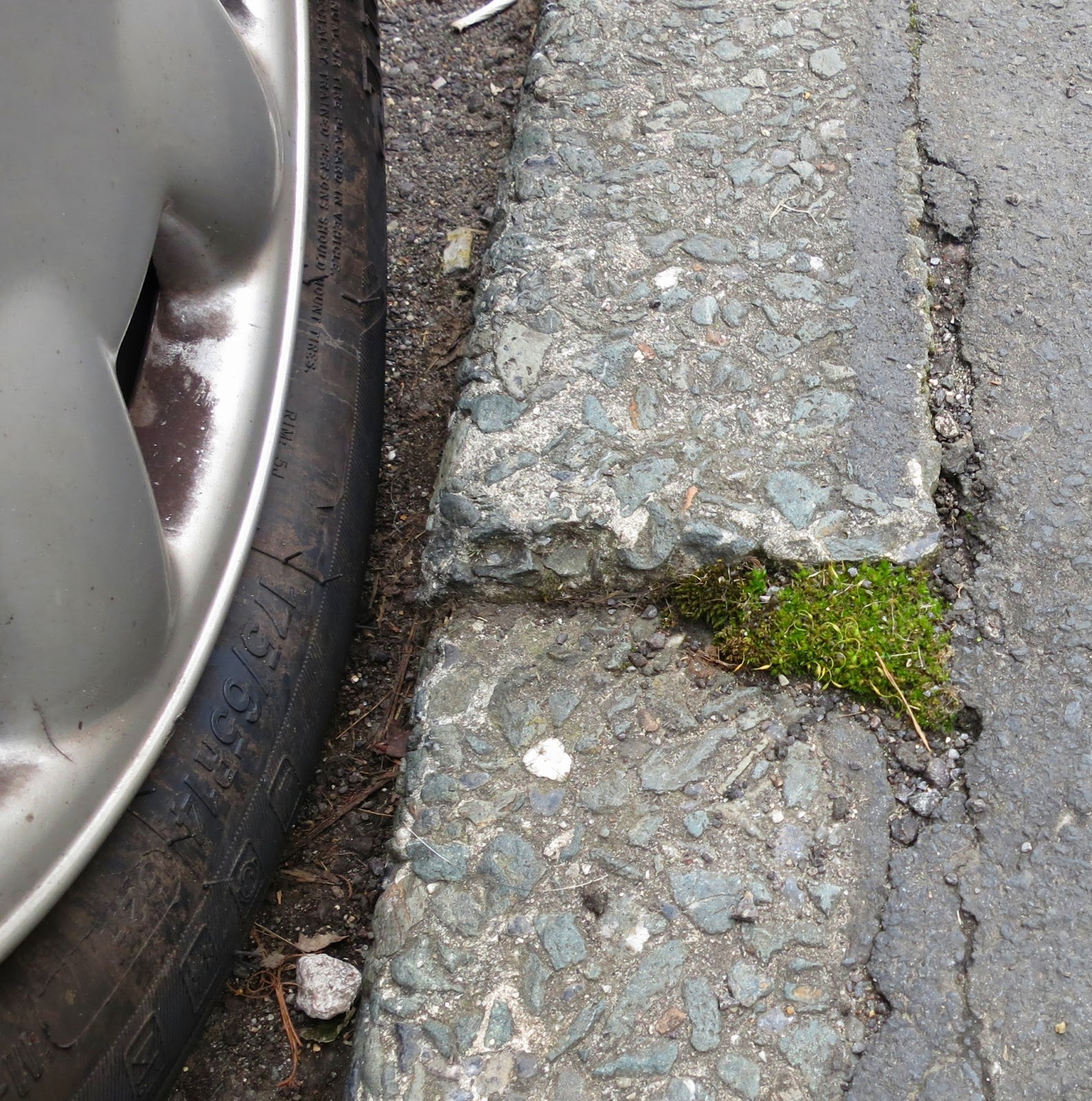
The green blob is not grass - it's a not-very-attractive patch of moss.
A prettier specimen comes later in this post.
I know, I know, I KNOW . . . we've had this out before . . . that the names of plants matter. And I KNOW that Loose and Leafy is an odd kind of blog and I probably owe it to my readers to find out what things are called so useful information can be recorded and passed on. BUT . . . er . . . I doubt many of you care two hoots either. When it comes to garden plants - that's different. If you see a good one on somebody else's blog, of course you need to know what it is so you can buy one if you would like one in your garden too. But, seriously, no-one is going to read Loose and Leafy and say 'Oh boy! Wouldn't I just like one of those little weeds to plant by my car. I must, I must, know what it is.' Of course not.

Though some . . . some are romantic. The Latin name for Common Whitlow grass is Erophila verna - which, roughly translated, means 'This plant loves spring' which is much better than naming it after a sore finger! But as it isn't yet spring in a decidedly 'sprung' sort of way, we'll have to wait for March before I start crawling around looking for that.

Not a wild plant but the head of a carnation lying in the middle of the path.
Do you know the programme 'Top Gear'? It's a programme about cars and I love it. It is extraordinarily sexist and I am a feminist - but I enjoy it just the same. It shows cars in remote and exotic places - hills, heather, mountains . . . and says they are driving around in the home-counties. And viewers are forever writing in to complain about it and point out there are no mountains in Kent or things like that. It promotes dangerously fast driving and I can't bear to be in a vehicle travelling more than about twenty miles an hour. The BBC is forever threatening to take it off the air because the three regular presenters are forever offending people (and the people who take offence may have serious, not pernickety, reasons for being offended.  . . . ). (All these 'forevers' are to emphasise how relentless the programme is in poking fun at people who might be offended. It's not an occasional slip. And it's relentless in it's never changing format too.)

I've recently come to realise how much my blog is like Top Gear. I know in advance that when I show pictures of litter here or my other blog (Message in a Milk Bottle) or fail to give proper recognition to the names of plants  - I know someone will (quite rightly) complain about litter or protest the importance of Latin. So I'm feeling rather chuffed.

Top Gear is one of the BBC's top income producing programmes (along with Dr Who) and Jeremy Clarkson (the main presenter) was reported to have earned £14 million in 2013. How's that for an example? Would it be fair to conclude the more complaints you receive the more money you'll earn? A good theory. I'm wondering if I might suggest all botanists have sore fingers . . . . and wait for the millions to role in?

Bother. I was getting so carried away with insulting you I forgot the moss on a wall. It blasted my mind. I'm dumbfounded by its colours. I keep looking at it on screen. Most of it is out of focus because I don't have the right lens for such tiny, tiny plants and my hands were shaking with cold. But you'll still see how overwhelmingly beautiful it is. Close up it's a forest of wonderfulness. Just goes to show - February (in England) is a time for looking small. (I will probably need to work harder on insulting people. Erm . . . suppose I say (block your ears if you don't want to hear this) mosses are prettier than roses . . .  will you send me a million pounds?)


Think February. Think mosses?

And if you would like to contribute a Street Plant Post to the next link box
Think 21st - 25th February

Sshhhh - some possibilities / suggestions
Top plant - Bittercress (probably Cardamine hirsuta)
The little green stars - possibly Pearlwort  (Sagina . . . um maybe Sagina subulata (Irish moss which isn't a moss!)  Or Sagina procumbens . . . ) (You see why it might be better not to bother!) )

Saturday, 14 February 2015

AND THEN THERE ARE STREET PLANTS

Tree overhanging building site hoarding.
No sooner is one task completed than another one is there. Isn't life wonderful?

The trees! So many trees in the February link box. Wonderful posts. Do you find as time goes by it gets interestinger and interestinger?

Next up - Street Plants.

Shadow of the tree on the building site hoarding.


I know it can sometimes feel as if one is lurching from one meme to another; but being aware of urban wild plants is something I would really like you to consider - whether you post about them on your blog or not.

Catkins on the tree in the superstore car-park


It's astonishing how many there are. Really.

I hitched a lift into Poole last week. 'Hurry, hurry,' said my friends as they got out of their car.
"But. . . look at these!"
"There are only two-and-a-half hours on the ticket and there's lots to do!"

By the time they'd stopped telling me to hurry and locked the car I'd already taken my pictures. I hadn't needed to go anywhere.

Cone from the tree lies on long and feathery plant branches beside the hoarding.

Right in front of our noses (or rather, our toes) were plants lined up against the pure white hoarding of a building site where a hotel is being constructed next to a superstore. Front wheels, pavement, plants - all in the shadow-shape of a car-park tree. (Alder?)

Dandelion, grass and other plants along the hoarding.


You don't need to know what they are. Just see them. There!

So - think about it. The link box for urban wild plants will be open 21st - 25th February.

There's even an Urban Wild Plants Page.

* * *


Sunday, 21 September 2014

THERE'S URBAN AND THERE'S URBAN


I have the unfortunate habit of setting out to take photos of plants when it's just about to rain, cloud over, turn into night-time or glare in the unfortunate way which dots white patches all over the place. Today's nigh-on fiasco was to go to the sea when the weather was wondering whether how much mist to through over the scene.

Such is life. Such is seizing the moment. It's often quite random the one you are free to seize.

And I didn't really chose this road either. It was where I happened to be when I looked to see what there was. In a way, the less promising the start, the more satisfying the conclusion.

Some kind of Sow Thistle?
Take the picture above. See the bollards on the pavement? (Over the road on the right.) I crossed to them and walked along beside the fence as far as the bend - the space of three lamposts. All the plants in this post were found along that span. In other words, they are in view - but you'd hardly know if you didn't look. This sow thistle, was about three inches high and caused enough of a blodge on the pristine brick pavement to stand out for a starter and draw me over. Notice the area is litter-free? That's often a bad sign when you're looking for street plants. But I was in luck. Not only is this sow thistle there but it has neighbours. There's some grass, and two others plants - one of them of the same ground-hugging kind as you'll see below.

People interested in sport and spectacle may remember that the sailing events for the 'London' Olympics of 2012 took place in Dorset and were based at the National Sailing Academy on Portland which had been developed with just that in mind.

I don't know what this plant is.
You can guess its size by comparing it with the bricks of the pavement and the small stone.
This road near The Academy is crisp and clear with nothing there beyond what's necessary. A road for cars. A pavement for people. Places for boats to spend the winter. Places for boats to be built and repaired. Warehouses. New. Stark.


(Well, not so new now - which shows how starkly maintained it is.)


It was tempting to brighten this picture to show the red pods more clearly.
But a grey day is a grey day.


There used to be huge oil tanks along this edge of Portland. They were dug up, knocked over, bashed out of the way and the ground levelled for the kinds of industries which take place in 'units'.

Some have plantings of grasses and other tough plants. I'm not sure if these clumps are truly wild or escapees.


The plant on the right) is  Knotgrass (Polygonum aviculare agg.). It was growing along the ground, away from the long blue fence, then standing upright. The segments of its stem looked as if they'd been plugged together in a row. It has pretty little pink flowers which are even less visible than the plant was when I started along the road.

(The clumps of something green along the building opposite are intentional plantings.)


It's not a flowery road. It's not a very flowery time of year. But here's another sow thistle; this time taller - with a yellow flower and white and fluffy wind-powered seeds and brightly coloured leaves.


And more flowers still?

Yes. By the last lampost before the road curves right . . .
The world seems full of different kinds of daisy-like flowers. I don't yet know what this is. Do you? (Take a look at its feathery leaves.)


Street Plant Bloggers
#urbanwildplants

From the long view - not much in the way of wild flowers.

Close to . . . ? Of course - they are always there!

* * *
Do you write about street plants on your blog? Join other Loose and Leafy readers by linking with your discoveries. See the Street Plant Bloggers page for more info.


For the September Street Plant Link Box
Click here.