Have Loose and Leafy Posts sent you by Email

Tuesday, January 31, 2012

ROUND A ROCK

This morning, it was cold; very cold. The frost was patchy but, when I went down to the sea at around twenty to ten, it was . . . finger chilling cold.


But the light was lovely.


I would usually aim for a little more variety in a post than there will be in this - but I fell in love with the colour and texture of seaweed on one rock.


I've been scrolling through these pictures over and over. I should get bored because they are all of the same thing. But I don't. I don't know why - I just don't!


I hope you like it too.


This little pool on the top of the rock is about two inches across.


And this is the next rock along. Same seaweed - different arrangement; a sort of skirt round the bottom!


While behind me - is the sea; with three Brent Geese swimming in the path of the sun.

I'd like to have taken the rocks home with me. I'd like to have taken the sea!

(But I think I'll need a little more in the way of storage before I'll try that! Indeed, I'd need a world full of garden sheds!)

This post is supported by Argos.

Saturday, January 28, 2012

THE NEW TREE - SAMBUCUS NIGRA

A few weeks ago, Laura at Patio Patch asked if I will be focusing on a new tree this year. I'd already been giving this some thought. My affection for 'last year's' tree (a Sycamore) began long before I gave it a special place on Loose and Leafy - so there's no way I'd let it out of view. However, it has the disadvantage of being so tall, all the 'action' happens high up. At ground level, shade and location mean its not a good place for other plants to grow . . . what little there is that struggles into life between its toes tends to get nibbled as soon as it shows its head above ground.

So a shift of focus might be a good idea.

A long time ago, I decided to 'follow' several trees and several patches of ground. All sorts of things went wrong - branches were lopped, the undergrowth was cut back, little plants died in drought or were trodden on - other plants caught my attention! In other words, it didn't work. None the less, there's an elder that has kept my interest all the way through. It's a scraggy thing - hardly a tree at all and only specially noticeable because it's bulked up by being part of a small clump. And the clump is both extra-noticeable and extra-easily-ignored because it is almost enveloped in blackberry and ivy. (Some of the recent photos of ivy berries were taken there.)

So, without abandoning the sycamore, let's shift focus and keep a little more of a conscious eye on the Elder - Sambucus Nigra.

It will be an incredible contrast. While the leaves of the sycamore are 'up there' and almost invisible (so high are its trunks before there are branches) the elder is definitely eye-level. And where the vegetation round the sycamore is sparse, so many plants like to live by and on and over the elder, it is sometimes hard to see it!

Deep breath . . . and a little fanfare . . . 
Tarantara!
and we approach the elder . . . through January gloom!


It's on a path we've met before - an old railway line that has been re-surfaced for pedestrians and cyclists.

There's the clump, up ahead on the left. (Further ahead still, on the right, you can see a group of Holm Oaks (Quercus Ilex)).

And we arrive.

For much of its route, the old railway runs along an embankment so, although the tree is easily accessible from this side, there's a quite a steep slope on the other.

Photographs can give the wrong impression of size. The elder is the wonky tree on the left. The little path which runs beside it is nothing more than an animal track. Maybe children push through from time to time. I'm not sure. Dens along here are not entirely out of fashion - though their occupancy seems to be very short - no sooner are they made than they are abandoned.


This is the foot of the tree - red shoots already showing. (I've heightened the contrast so you can see the patterns in the bark.)

Because the elders here are tightly packed, I'm not going to be too particular about which branches belong to which particular tree. We'll take the clump as a unity.


An untidy one!

Useful Link

The Woodland Trust has an interesting page about the Elder HERE
with information botanical, historical and folkloragorical.


'Festival of the Trees' has now become 'Treeblogging'.
'The Tree Year' has come to a stop - or has it?

Tuesday, January 17, 2012

BLACKBERRIES IN THE GLOOM

There have been some lovely sunny, blue sky days recently but, for the most part, those have been the days when I haven't had time to go out with my camera. So I've been missing the startlingly crisp afternoons when one can take startlingly crisp pictures . . . and have been left with gloomy days - days when everything sort of merges into a mush. All that means, of course, is that we are invited to look a little harder.

Here we go - the big scene (which is never very big - too much choice!) . . . and the view when we hone in. It's a bit like a spy film. And today - today we are spying on blackberries.

First, the bramble picture from the recent Loose and Leafy post 'Prickles and Thorns'.


At least it's clear what the photo is off. None the less


go closer in and one is less aware of the shape of the branch and more of the arrangement of thorns. I even find myself wondering what happened to the missing limb.

Blackberry fruits which weren't eaten and didn't fall.


I could, of course, have walked on by. Most people would. Most people are simply marching down a path or walking back. They aren't out with a camera with a post in mind. I'm glad I had my eyes skinned.


Leaves which hang on to autumn stand out more, even at ground level.


But there's a world in there which could be missed if we didn't go in closer still.


Perhaps there should be a little sign beside it: 'INSECTS AT WORK!'

And, far less obtrusive, agreeing to stay muted - a dessicated twig.


Sometimes, the tiniest of details need their own frame.

Friday, January 13, 2012

THE BERRIES MATURE

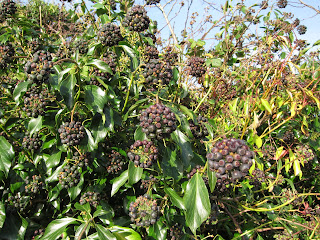
It's possible, I suppose, a moment may come when I loose my interest in ivy. For the moment, though, it runs un-diminished. Their earlier golds have mostly vanished. Instead, there are blues and greens and browns on show. It's very hard to move on.

Sometimes, I adjust pictures a little - cut out glare from shiny leaves, take a few shadows away to reveal detail. This time, so you can tell how wonderful the variety is, so you know it hasn't been introduced by editing, the pictures for this post are exactly as they came out of the camera (except for cropping off some of the edges so you can see the berries centre stage).

Can't wait to hear what you think!


There are olive greens.


And chestnut browns.


And blueberry blues.


Some are hanging low where the new Alexanders grow.


And some hang on to memories of autumn fireworks.


There are masses and masses of them.


Beautiful.


Thursday, January 5, 2012

A PAUSE TO LOOK AT REEDS


Reeds are here all year round but when bushes die back and green fades out of the landscape they come into their own.


In the summer, there will be flowers either side of this path - daisies and vetches and all sorts of things I don't know the names for but, for now, reeds dominate


 - and they won't stand still. It has been very windy recently. Indeed, to take these pictures it was, at times, hard to stand still, the wind was buffeting so much. They are being blown sideways - and I am too. Weather is contrary. Clouds are coming from the north but wind from the west. This means it is not too cold. An east wind is the coldest here.


It comes blasting up the English Channel. The coast you see is the south coast of Dorset - heading from Weymouth to Kimmeridge and Lulworth.


As evening falls, the light grows colder and the reeds turn silvery


and dull


and dramatic.
(The little white dot in the sky to the right of the reed head is the moon.)


I like reeds.

Photographs taken on the 2nd and 5th of January 2012.
I'm at sea with botanical names. Is Phragmites Communis the same as Phragmites australis?

Tuesday, January 3, 2012

PRICKLES AND THORNS

When the weather grows cold and blustery, it’s tempting to look for signs of new growth but do that too much and one misses the season. In January, there’s more dead on show than usual; prickles show clear and thorns are beautifully exposed.


Gorse flowers all year round but in January, when there is less colour than in  other months, the flowers are specially prominent in the dull light.


January is a month when it's easy to see where blackthorn gets its name. Come spring, white blossom will draw the eye and in the summer these long spikes will be hidden in dense foliage.


For most of the year, blackberries mean fruit at some stage but January is a 'look at those thorns!' time.


Buddleia is an exception to this general 'now-ness'. Last years dead blossoms remind us of the year passed.

Hurray for January!

Have a Very Happy

2012

!