Those who do not live near ivy may not realise how poplar it is with insects. When it is in flower, you can hear them buzzing loudly as you approach.
In the last week, I have been taking pictures of ivy in various stages - buds, flowers, beginnings of berries. The weather has been variable so I've been going backwards and forwards, trying out different lights.
Sometimes, there were three insects per mini-firework display so my attention drifted to them . . . and from them to ladybirds in the leaves . . . and from ladybirds to realising there are Harlequins here - Harmonia axyridis.
 |
| Harlequin Ladybird -Harmonia axyridis |
The good thing about these ladybirds is that they eat lots of aphids. That's why, in 1988, some were taken from Asia and introduced into the U.S.A..
The trouble is, these ladybirds have such a great appetite for aphids . . . they gobble up every single available one of them. Indigenous ladybirds begin to starve to death. Does this bother the Harlequins? No. They extend their diet to include the already declining species of local ladybirds . . . and lacewings . . . and butterflies . . . and hoverflies . . .
Their population is expanding. It is now the most widespread ladybird in North America and some species which used to be common in Canada are now rare.
 |
| Un-hatched Harlequin pupa |
Bizarrely, despite this experience, Harlequins were introduced to mainland Europe as a device of pest control . . . and then they flew to the British Isles.
 |
The empty skin of a hatched
Harlequin pupa. |
There is a lot of alarm about this (naturally!) so the UK Ladybird Survey has set up a special section for monitoring their spread here.
It's almost useless to explain what to look for because although the Harlequins I came across on the ivy look much like 'ordinary' ladybirds, they can come in a surprising number of guises. (Disguises!) The best thing (I suggest) for people in the UK to do is to
submit photos of ANY ladybird to the
UK Ladybird Survey. Not only will they be able to distinguish one species from another, it's as important to record the distribution and numbers of indigenous ladybirds as it is to make
a map of Harlequin spread. The impact of Harlequins needs to be monitored - and it's good to keep an eye on what's happening to our wildlife whether or not we have concerns about the activities of a particular predator.
 |
Another empty skin of a hatched
Harlequin pupa. |
But what about other insects on the ivy?
I went back to take photographs. The weather had cooled - was it this which meant there were fewer around - or was it that the sun was shining on the bushes and the insects preferred shade? . . .
I don't know - but whatever the reason was, as soon as I decided to pay attention to insects, most of them vanished. But there was a Blowfly next to a Harlequin -
And a Drone Fly. (Probably E. tenex).
And a moth. (Possibly a Nettle-Tap - Anthophila fabriciana).

The rest kept flying around, buzzing off, flitting away - if only they had been prepared to sit as still as this snail!
SOME LINKS YOU MIGHT LIKE
History of Harlequin invasion - on this page there is information about how to send live ladybirds to the Department of Genetics at Cambridge University. The address for this has changed and specimens are no longer needed from certain areas. Details are on the right hand side of
THIS page, the address to which ladybirds may now be sent is on the left.
Using sexually transmitted disease to render Harlequin females sterile is being studied at Cambridge University but parasites are another form of control. You might like to take part in a
parasite survey on the
BBC Breathing Spaces site.
And . . . I know I'm always going on about
iSpot . . . but it really is worth belonging to / contributing to if you live in the UK.
For readers in other parts of the world . . . there seem to be no parallel ways for people who live on mainland Europe to take part in surveys like these. It may be that there are some in North America . . . if there are, I'll add information here . . . or does anyone already know?
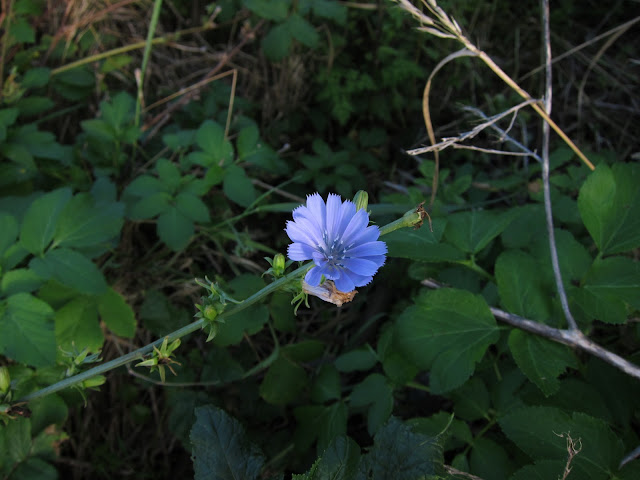
 A few years ago, I complained to our local council that it cut back blackberry bushes when fruit was on them - and, at the same time, raised questions about the spring trim in relation to nesting birds. I don't claim it was my email alone which got it changed. Indeed, it may have had absolutely nothing to do with it but, since then, the autumn tidy has happened later - and they've just done it so only the shorter chicory plants are still standing. They've had a bit of a tough time this year because the spring trim happened immediately after the first were tall. They are one of my favourite plants so I was pleased when others grew to replace them. I will miss the tall white stems they would have left through the winter if they'd been left uncut but there's no point in a path if you can't walk along it!


